
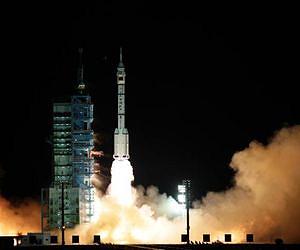
In recent weeks China has appeared prominently in the international media. To the layman it would seem that the Asian superpower is advancing its space technology and exploration program at warp speed and may overtake the American space program very soon. Most recently its Shenzhou-9 spacecraft successfully docked with the orbiting Tiangong-1 space lab.
This was the country's first space flight with a female astronaut and its first docking in orbit.
The Shenzhou-9 spacecraft lifted off on June 16, 2012 and returned to Earth on June 29, 2012. When the docking took place on June 18, China was heralded as a new technological leader in the space race.
While it is true that China is now one of three countries that have sent women into space and docked two spacecraft in orbit, there appears to be some question as to how much of a space leader this country really is. For example, the Soviet Union launched pairs of satellites as early as 1962, i.e., Vostok 3 and 4.
However, technology for docking was not quite ready. In 1963, a young USAF major submitted his MIT doctoral thesis titled, Line-Of-Sight Guidance Techniques for Manned Orbital Rendezvous.
The author was Major Edwin Eugene Aldrin, Jr., better known today as Buzz Aldrin. Later, as a NASA astronaut, Buzz applied his theory to actual space flight operations, leading to the first US attempted rendezvous in 1965 by astronaut Jim McDivitt.
Jim tried to maneuver his Gemini 4 to meet with its spent Titan II upper stage, but was unable to get close enough to achieve stationkeeping. NASA engineers had not yet understood the orbital dynamics of the rendezvous and docking.
However, NASA engineers got smart and the first successful rendezvous was accomplished by US astronaut Wally Schirra on December 15, 1965. Schirra maneuvered the Gemini 6 spacecraft within 30 cm of its sister craft Gemini 7. The two spacecraft were not equipped with docking mechanisms, but stationkeeping was maintained for more than 20 minutes.
Finally, the first docking of two spacecraft was achieved on March 16, 1966 when Neil Armstrong guided Gemini 8 to a docking with an unmanned Agena Target Vehicle.
Thus, it would appear that China's space program still has a long way to go to catch up with the U.S. In fact, China has yet to build a reusable launch system, send astronauts beyond low earth orbit, walk on the moon or land a robotic spacecraft on an asteroid.
Let's check China's space progress again in about 50 years.
