
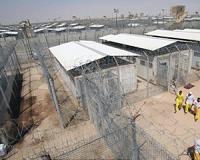
Iraq's prime minister is seeking to speed up the implementation of death sentences, his office said Saturday, despite persistent concerns over flaws in the judicial system that hands them down.
Prime Minister Haider al-Abadi ordered the formation of a committee "to determine the obstacles and causes that result in the delay in the implementation of death sentences," a statement said.
The committee is to make recommendations to "speed up the ratification of those sentences and their implementation," it said.
Iraq has for years faced widespread criticism from diplomats, analysts and human rights groups who have said that, due to a flawed justice system, those being executed are not necessarily guilty of the crimes for which they were sentenced to die.
Following a bombing in Baghdad that killed nearly 300 people earlier this month, the justice ministry announced that five people had been put to death in a statement linking the timing of the executions with the blast.
Rights group Amnesty International subsequently repeated calls for a halt to executions in the country, saying that more than 100 had been carried out so far in Iraq this year.
"Amnesty International has repeatedly called on the Iraqi government to halt executions," it said.
"Death sentences are frequently handed out by courts following grossly unfair trials marred by the use of 'confessions' extracted under torture," Amnesty said.
Iraq's Karbala votes for return of displaced people
Najaf, Iraq (AFP) July 22, 2016 –
Authorities in Iraq's Karbala province have voted for the return of all displaced Iraqis whose home areas have been recaptured from the Islamic State group, they announced on Friday.
Millions of people have fled their homes to escape violence in Iraq, but many areas that have been retaken from IS jihadists are still littered with bombs and heavily damaged, making returning difficult.
"The Karbala provincial council voted unanimously on a decision to return all the displaced people who came to Karbala," its chief Nasayif al-Khattabi said in a statement, adding that it applies to those "whose areas were liberated."
The decision was made "to preserve the security situation in Iraq in general and Karbala province specifically," he said.
Mahfudh al-Tamimi, the head of the provincial council's legal committee, said that the process would not be compulsory.
"It will be implemented voluntarily," Tamimi said.
"The decision is an attempt to guarantee the return of the displaced officially and legally without exposing them to danger," he said.
The United Nations refugee agency has warned against premature or forcible returns of displaced Iraqis.
"It is important to ensure conditions are in place for (the) return to take place in safety and to be sustainable," UNHCR said earlier this month.
And "it is important that displaced families can make a choice about when they feel it is safe to return and are not forced into making a decision," it said.
IS overran large areas north and west of Baghdad in 2014, but Iraqi forces have since regained significant ground from the jihadists.
But many areas retaken from IS are still full of bombs left by the jihadists that must be cleared before residents can return — a time-consuming process that is in its early stages in many places.
And displaced Iraqis may not have a home to return to even if they wanted to due to destruction caused by the fighting to force the jihadists out.
