
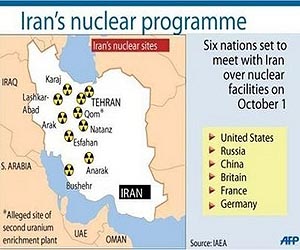
Iran's top nuclear negotiator Saeed Jalili said on Monday the West has to give a "correct assessment" of his country's atomic capabilities in important talks due to be held in Baghdad next week.
Jalili, speaking to visiting Iraqi Prime Minister Nuri al-Maliki, said such a stance was needed for the talks to be successful, according to Iran's official IRNA news agency.
"The outcome of the Baghdad meeting relies on a correct assessment by the West of Iran's national, regional and international capability," Jalili said.
The countries involved in the talks should realise that the Islamic state has a "consistent determination to consolidate and upgrade its capabilities," he was quoted as saying.
Although the IRNA report did not elaborate, Jalili's comments could imply a demand that the Western powers involved in the talks acknowledge that Iran had a right to continue key aspects of its disputed nuclear programme.
Activities Iran has developed in recent months and years include enriching uranium to 3.5 percent and to 20 percent.
The former is needed for atomic energy, while the latter can be used to make medical isotopes — or, if enriched further to a military-grade 90 percent, to make nuclear weapons.
The issue of Iran's uranium enrichment is seen as one of the headline issues of the May 23 talks in Baghdad between Jalili and representatives of the so-called P5+1 group, which comprises the five permanent UN Security Council members plus Germany.
Iran and the P5+1 met in Istanbul on April 14 for the first time in 15 months, and agreed to hold the more substantive round of negotiations in the Iraqi capital.
The UN Security Council has imposed four rounds of sanctions on Iran over suspicions that its avowed civilian nuclear programme is a cover for a secret atomic weapons drive, a charge vigorously denied by Tehran.
Iranian foreign minister 'optimistic' on nuclear talks
Tunis (AFP) April 23, 2012 –
Iranian Foreign Minister Ali Akbar Salehi said Monday he was optimistic about upcoming nuclear talks in Baghdad with world powers.
Iran resumed dialogue on its nuclear capabilities April 14 at talks in Istanbul with the United Nations Security Council's five permanent members — France, the US, Britain, China and Russia — plus Germany.
"The results of the meeting in Istanbul were satisfactory and I am optimistic about the next meeting in Baghdad," he told reporters during a two-day official visit to Tunisia.
The Baghdad talks are planned for May 23.
The Security Council has imposed four rounds of sanctions on Iran over suspicions that its avowed civilian nuclear programme is a cover for a secret atomic weapons drive, a charge vigorously denied by Tehran.
Salehi downplayed threats Israel has made to launch pre-emptive attacks on Iran's nuclear sites.
"Israel's threats to attack Iran are a bluff," he said. "But we take them seriously and are ready to defend ourselves."
