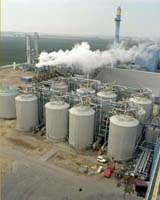
Brazil, the United States, China and three other partners on Friday launched a forum to spur a global market for biofuels seen as a cleaner, economically viable alternative to fossil fuels. The European Commission, India and South Africa joined the initiative which was announced at a press conference at UN headquarters.
"Biofuels constitute a viable economic alternative for the immediate partial substitution of fossil fuels and the diversification of the world's energy mix," Brazilian Ambassador to the United States Antonio Patriota said as he formally announced the launch of the International Biofuels Forum.
"The introduction of biofuels is highly advantageous both for developing and developed countries," he added.
The Forum aims to create a world market to spur production, distribution and use of biofuels, which can also help reduce greenhouse gas emissions which contribute to global warming.
Participants are to advance coordination on priority issues and establish working groups on information exchange and standards and codes.
The forum will convene regular meetings over the coming year to pave the way for an international conference on biofuels in Brazil in 2008.
The initiative was launched less than a week before US President George W. Bush is to visit Brazil to discuss ethanol cooperation with his Brazilian counterpart Luiz Inacio Lula da Silva.
Brazil and the United States together control more than 70 percent of the world's ethanol market, but countries such as China, India and South Africa have huge potential to develop their own biofuel production.
Ethanol is mostly derived from corn in the United States and in Brazil from sugar cane.
"By working together we will be able to identify means and ways to help countries with agricultural productive potential to become major energy suppliers," said US Assistant Secretary of State for Western Hemisphere Affairs Thomas Shannon. "This is a huge step forward in the development of a new international understanding of energy."
Use of biofuels such as ethanol means drastically cutting developing countries' dependence on imported oil, redressing their trade imbalances and saving income in order to increase investments in health, education and social development.
It can also create income and reduce the migration of rural populations to urban areas, Patriota noted.
Biofuels are also attractive for developed countries as they can boost energy security by reducing dependence on fossil fuels and reduce greenhouse emissions, he added.
Brazil, which according to a recently unveiled project could produce enough ethanol to replace 10 percent of world gasoline demand in the next 20 years, has offered its expertise in the field to several developing countries.
The Brazilian project, developed with the participation of the government and state-owned oil giant Petrobas, would multiply by 15 times the country's current production of ethanol from sugar cane.
Underpinning Brazil's success has been the mass-marketing since 2003 of hybrid-fuel cars, which consume either pure ethanol or a five-to-one mix of gasoline and ethanol. There are now more than 2.6 million such vehicles in the domestic market.
When he arrives in Brazil next week on the first leg of a week-long Latin American tour, Bush will face pressure to lower US trade tariffs on Brazilian ethanol.
Brazilian foreign minister Celso Amorim stressed Wednesday that ethanol and biofuels in general would be a "very important" theme of the Lula-Bush meeting next Friday in Sao Paulo. "We are interested in forming a global ethanol market," he said.
Amorim said Brazil intended to put the tariffs issue "on the table," but added: "I don't know if that will be resolved all at once."
Source: Agence France-Presse