
Long known as the collective mecca of cutting-edge industrial robot technology, Japanese manufacturers are now welcoming a newcomer from outside the ranks. Sumitomo Heavy Industries (SHI) hopes that such a move may force a rethinking of the status quo.
SHI made a splash in November 2015 with the announcement that it had inked an exclusive distribution agreement with Rethink Robotics to market, service and sell the Boston-based firm's new "Sawyer" robot to domestic manufacturers.
The Sawyer is billed as a revolutionary high-performance 'collaborative' robot designed for circuit board testing and other precise tasks that are not practical to automate with traditional industrial robots. It needs no safety cages, complex programming or costly integration.
For a machine of its class, the Sawyer is perhaps as easy to use as they come, thanks to its Intera interactive graphical user interface, which allows training by demonstration and context instead of coordinates to enable non-technical personnel to create and modify programs as needed. Intera undergoes constant upgrading and is presently on version 3.3.
"Broadly speaking, Japanese robot companies are great at making hardware good for replacing hundreds of human line workers who would do repetitive tasks. That's ok if you're making exactly the same product all the time," says SHI marketing agent Yosuke Shikimori at a summer factory automation trade fair in Odaiba.
"But global manufacturing is moving from mass production to mass customization, which requires quickly re-purposing robots to do different things according to varying product specs. This is where robots like the Sawyer have a distinct advantage."
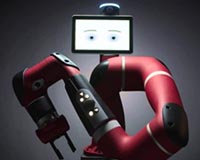
A working Sawyer unit demonstrated its dexterity by manipulating some plastic containers at SHI's booth at the expo. Standing on a wheeled all-red torso at human height, the machine is not imposing despite its robust multi-jointed arm. It features a camera in the wrist, a wide-view camera in the head, and high resolution force sensors embedded at each joint. Running on standard wall current, its arm, torso, and head allow multiple degrees of freedom along with integrated vision, robot control, and safety systems.
The arm weighs 42 pounds and can carry up to nine pounds. Orders can be custom built to precise customer specs.
At around 5 million yen per copy, the machine does not seem inordinately expensive considering its capabilities. In fact, the machine's flexibility affords the option of leasing it out for short-term contract work, opening another way for owners to increase their investment return, notes Mr. Shikimori.
"Companies like Fanuc and others run their robots on proprietary, highly specialized software, and keep teams of programmers and technicians ready to respond to their clients' service requests when something goes wrong," he says. "The Sawyer removes that barrier of complexity."
Rethink Robotics was founded in 2010 by Rodney Brooks, an Australian who rose to fame as the creator of the Roomba, a programmable, automated room vacuum cleaner robot, in 2002. The device proved to be a hit, selling over 10 million copies over the next dozen years.
The Sawyer reflects evolutionary improvements on Rethink Robotics' prior flagship robot, the Baxter, which had some flaws. Sawyer is designed to perform so-called "machine tending" tasks, which generally require a human to stand next to a piece of machinery inserting and removing parts.
An example is an "in-circuit test" in which a worker inserts a newly produced circuit board into a machine, waits for the machine to run a brief test of the part's quality, and then takes the part out and moves it down the line. The Sawyer relies on an advanced force-sensing system to "feel its way" into the testing machine without damaging it or the part, and place it in the desired position, writes MIT Technology Review's Mike Orcutt.
The Sawyer may be hitting the market at a very good juncture. One industry report said sales of the older Baxter unit were increasing 40%-70% each quarter, thanks to a June 2015 software fix, while Sawyer sales were already backlogged.
More recently, The Boston Consulting Group (BCG) noted that the era of moving factories to capitalize on low-cost labor is coming to an end, albeit not for every product.
"This can already be seen in the transportation, computer, and electrical equipment sectors; the size of the manufacturing plant will be far less important as an economic driver than it is today," it said, predicting that manufacturers in some industries will no longer need traditional, permanent production lines.
"Even small and medium-sized enterprises (SMEs) can participate as new robots cost as little as $25,000 with attractive economics," BCG said.
