
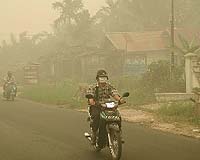
Indonesia said Tuesday it was confident of reducing the number of illegal fires or "hotspots" this year, as the region braces for the annual dry-season haze crisis.
Indonesia's environment minister Rachmat Witoelar said hotspots had been reduced by 51 percent in 2007 in key provinces and this pace of improvement should continue.
"We are consolidating our efforts and working together with our neighbours," he said after talks with his counterparts.
"We have significantly reduced the number of hotspots in both Kalimantan and Sumatra since last year, and we hope to maintain this trend in 2008 with cooperation from our neighbours."
Ministers and officials from Brunei, Indonesia, Malaysia, Singapore and Thailand held half-day talks on measures to fight the haze phenomenon, which chokes the region each year, hampering travel and causing health problems.
They said in a statement that the La Nina weather system was expected to ease this year, "leading to drier periods and the possibility of escalating hotspot activities," so urgent action was required.
"We will be prepared for the worst but hope for the best," Witoelar said, while noting that Indonesia's vast tracts of dry and combustible peatland would make fighting forest fires difficult.
"We are not trying to delude ourselves that we are going to wipe out all the haze… but we are focusing on preventing transboundary haze in our national action plan," he said.
Witoelar said stiff penalties of up to 10 billion rupiah (1.1 million dollars) and 10-year jail terms will be meted out to major plantation owners who defy the law against open burning.
Farmers have also been educated and received incentives to clear land using alternatives to traditional slash-and-burn methods.
Indonesia has yet to ratify a regional treaty charted in 2002 on preventing the haze, but officials said it was in the process of doing so.
Indonesia and the Philippines are the only members of the 10-nation Southeast Asian bloc who have not ratified the deal, which would compel Indonesia to create a strict zero-burning policy.
The haze hit its worst level in 1997-98, costing the region an estimated nine billion dollars by disrupting air travel, tourism and other business activities as smoke enveloped the region.
The five nations again meet on the issue on June 26 in Singapore.
