
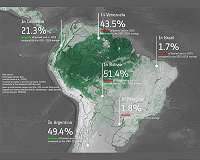
To protect the Amazonian rainforest, new research suggests full property rights for tribal lands be extended to Brazil's indigenous communities.
For the study, researchers at the University California, San Diego, used satellite data of vegetation coverage in the Amazon rainforest to study deforestation patterns between 1982 and 2016. Scientists compared the results of their mapping efforts with Brazilian government records of indigenous property rights.
The analysis, detailed Tuesday in the journal Proceedings of the National Academy of Sciences, showed land owned fully and collectively by local tribes featured a 66 percent reduction in deforestation rates.
"Indigenous traditional land use, based on collective ownership, has been associated with the preservation of a land's biodiversity," researcher Kathryn Baragwanath, postdoctoral candidate in the political science department at UCSD, told UPI.
One study published earlier this year showed land stewardship by indigenous communities was associated with greater levels of carbon sequestration.
Baragwanath said these positive ecological impacts are strengthened when indigenous communities have the full scope of property rights and legal tools to defend tribal lands from commercial interests.
"These legal rights ensure that the boundaries can no longer be contested, the territory is registered in the national land registry, the government is constitutionally responsible for protecting the territories and the territorial resources are considered to belong to indigenous peoples," she said.
When conducting their analysis, Baragwanath and researchers accounted for variables besides indigenous property rites — including proximity to roads, mining projects and rivers, elevation, population density and rainfall.
In Brazil, the process of gaining full property rights, called homologation, is complex — at least partially because government agencies there have been slow to review applications, researchers said.
Often, as the process plays out at a snail's pace, commercial interests will start illegal mining or logging, so they can later argue that they've established "productive use of land," researchers said.
To protect the Amazon and the region's remaining forests, Baragwanath suggests Brazil's government strengthen their environmental agencies.
"Public policy should focus on granting full property rights to the indigenous peoples who have not yet received their rights," she said.
Amazon fires a 'lie' says Brazil's Bolsonaro
Rio De Janeiro (AFP) Aug 12, 2020 –
Brazilian President Jair Bolsonaro has said it is a "lie" that fires are ravaging the Amazon rainforest, despite data from his own government showing the number of blazes is rising.
The far-right leader has faced international condemnation for presiding over huge fires and rising deforestation in the Amazon — criticism he took issue with in a speech to a video conference of countries that share the world's biggest rainforest.
"Tropical rainforest doesn't catch fire. So this story that the Amazon is burning is a lie, and we have to fight it with real numbers," he said Tuesday.
Yet satellite data from Brazil's national space agency, INPE, show the number of forest fires in the Brazilian Amazon last month rose 28 percent from July 2019, to 6,803.
Experts say the fires are typically not sparked naturally, but set by humans to clear land illegally for farming and ranching.
Last year, huge fires devastated the Amazon from May to October, sending a thick haze of black smoke all the way to Sao Paulo, thousands of kilometers away.
The fires triggered worldwide alarm over a forest seen as vital to curbing climate change.
Experts warn this year's dry season, which is just getting started, could see even more fires.
The scrutiny is pressuring Bolsonaro, who has called for protected Amazon lands to be opened up to mining and agriculture.
He has deployed the army to the Amazon basin, 60 percent of which is in Brazil, to fight fires and deforestation, declared a ban on agricultural fires and launched a task force to combat the problem.
He said that was producing results, pointing to a more than 25-percent reduction in deforestation year-on-year last month.
"We are making big, enormous efforts to fight fires and deforestation, but even so, we are criticized," he told the meeting of the Leticia Pact, a group launched last year to protect the Amazon.
His government has been accused of cherry-picking data by trumpeting the July drop in deforestation.
Despite the one-month decline, deforestation in the Brazilian Amazon set a new record high in the first seven months of the year, according to INPE data.
