
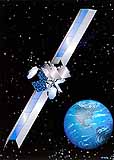
Hughes Space and Communications has expanded its satellite line to include two enhanced spacecraft products, the HS 601+ and the HS 702+. The satellites are extensions of HSC's existing product line models and will enable HSC to offer the full range of power from 2 kw to 25 kw.
"More than a decade ago, we introduced the HS 601 spacecraft, which is today the world's most purchased commercial satellite," said Tig H. Krekel, president and chief executive officer of HSC. "Seventy-five of these have been ordered by 17 customers. Four years ago, we announced our latest and then most-powerful spacecraft, the HS 702, the first of which is scheduled to launch this year. Nine of these powerhouses are currently on order.
"Today, we've raised the bar, and have even further expanded the capabilities of the HS 601 and HS 702 satellites, increasing both, with the HS 702 able to grow to 25 kw," he said. "We have coupled our 35 years of technical heritage with major enhancements to current technologies. The result is incremental, highly leveraged improvements to our existing designs that are available now, while we continue to develop the satellite designs of the future."
One of the primary enabling technologies is more efficient solar cells. Spectrolab, another unit of Hughes Electronics, has achieved 27 percent efficiency in its most efficient solar cells to date — triple-junction gallium-arsenide solar cells — and is developing future designs exceeding 35 percent.
Advances in energy storage, innovative thermal management systems, a highly efficient propulsion system, XIPS, and continued miniaturization of electronics combine to provide the technological improvements necessary to provide this increased capability.
"Our market research tells us that our customers want more capability, and they want it now," Krekel said. "For that reason, each of our models is designed for easy expansion, which translates into an ability to incorporate enhanced technology quickly. Our HS 601, for example, was designed with increased power in mind; therefore, heat dissipation and the other effects of increased satellite power are addressed in this upgradable design.
"I believe many of our existing and future customers will respond favorably to this expanded line, and we are offering it in current marketing submittals to operators of both large and small satellite fleets," he said.
