
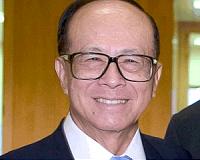
Hong Kong's richest man Li Ka-shing announced Friday he was stepping down as chairman of his flagship company CK Hutchison, marking the end of an era for one of the world's most storied tycoons.
Li, a wartime refugee, got his start in 1950 making plastic flowers and over the years built a sprawling conglomerate that has become part of the fabric of Hong Kong life, ranging from internet services to supermarket chains.
Smiling occasionally as he spoke with reporters on Friday, Li said he was "happy and honoured" for the opportunities he has had, bowing as he thanked others for their support.
"Looking back all these years, it's my honour to have founded Cheung Kong and to have served society," he told the packed room, referring to his company's original name.
Nicknamed "Superman", Li's decisions set market trends, with the potential to affect property and utility prices for the city's seven million residents.
The billionaire, who turns 90 in July, said he would step down on May 10 at the company's annual general meeting, ending mounting speculation about his retirement.
He added he would serve as the company's "senior advisor" and will hand over the reins to his eldest son Victor.
Li never gave a straight answer when asked about retirement at previous press conferences, but a sweeping revamp of his vast empire in 2015 was seen as a sign that he was paving the way for Victor to take over.
– 'Vote for Xi' –
Li did not shy away from controversial topics at Friday's press conference, taking questions on China's historic constitutional amendment earlier this month to give President Xi Jinping a mandate to rule for life.
"If I had the right to vote, I would vote for him," Li said, adding China's anti-graft campaign has been effective in recent years.
He also voiced concern over housing conditions in Hong Kong, where property prices are among the world's most expensive, forcing some small businesses to close due to sky-high costs while many residents cannot afford to buy or rent decent homes.
The wealth gap last year was at its widest for nearly 50 years, fuelling discontent as the former British colony marked two decades under Chinese rule.
"Our property prices have broken off with ordinary people's incomes. We especially need more public housing so that, for the general public, their living situation won't become their biggest difficulty," the mogul said.
The Center, a landmark Hong Kong skyscraper owned by Li's CK Asset, sold for a record price of more than $5 billion last year, indicating the city's booming property sector was not cooling down.
Li's flagship CK Hutchison controls diverse assets in over 50 countries, and has recently counted Europe as a significant income source.
His Cheung Kong Infrastructure company operates development, investment and infrastructure businesses in mainland China, Britain, Canada and other countries.
Local legend has it that Li can even control the weather — ensuring typhoons do not hit Hong Kong during the working day.
Practically speaking, Li's career concluded on a high note as his companies including CK Hutchison and CK Asset reported higher full-year profits in results released Friday.
China slams UK warnings about Hong Kong liberties
Beijing (AFP) March 16, 2018 –
Beijing hit back Friday at Britain over a report condemning jailings of democracy activists and the disqualification of rebel lawmakers in Hong Kong.
"There is no room or right for the UK to intervene," foreign ministry spokesman Lu Kang told a regular briefing.
"The attempt to show the UK's influence on Hong Kong affairs is in vain and can only lead to Chinese people's antipathy," he added, referring to Britain's former role as the city's colonial ruler.
The six-monthly parliamentary report on Hong Kong came days after the Chinese Communist Party decided to give President Xi Jinping a mandate to rule for life, intensifying fears that Hong Kong's freedoms will come under increasing threat.
Last Monday, the city's democracy camp failed to claw back all their lost seats in controversial by-elections as the city's pro-Beijing establishment further cements its grip.
Since being handed back to China by Britain in 1997, semi-autonomous Hong Kong has enjoyed rights unseen on the mainland, such as freedom of speech and an independent judiciary.
But there are increasing concerns those liberties are under threat.
Britain's foreign secretary Boris Johnson said Thursday the denial of entry to Hong Kong in October of British human rights activist Benedict Rogers had fuelled the UK's concern.
"Beijing's involvement in this case has strengthened our view that Hong Kong's high degree of autonomy is under increasing pressure," Johnson said in the report.
He also emphasised the importance of a free and fair judiciary after the jailings of leading pro-democracy activists on protest-related charges and the ousting from the legislature of four rebel lawmakers after an intervention from Beijing.
Johnson said that while the judiciary "remains in high esteem", it was vital the government was "seen to use the system fairly in all cases".
Hong Kong has come under increased pressure from Beijing since mass pro-democracy rallies in 2014 brought parts of the city to a standstill.
The rallies failed to win political reform and since then activists have emerged calling for self-determination or full independence from China, infuriating Beijing.
