
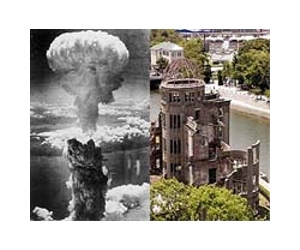
Sixty-five years after the destruction of Hiroshima in an atomic inferno, the United States will for the first time send an envoy on Friday to commemorate the bombing that rang in the nuclear age.
Its World War II allies Britain and France, both declared nuclear powers, will also send their first diplomats to the ceremony in the western Japanese city in a sign of support for the goal of nuclear disarmament.
Japan, the only country that has ever been attacked with atomic weapons — first on August 6, 1945 in Hiroshima, and three days later in Nagasaki — has pushed for their abolition ever since.
US ambassador John Roos will attend the ceremony, which is held each year to remember the attack, reflecting US President Barack Obama's push for a world without nuclear weapons.
United Nations Secretary General Ban Ki-moon will also attend, becoming the first UN chief to take part in the annual event at the Hiroshima Peace Memorial.
"The only way to ensure that such weapons will never again be used is to eliminate them all," Ban said on Thursday as he met elderly survivors, known as "hibakusha", at the site of the Nagasaki blast.
The Hiroshima Peace Memorial Ceremony will begin at 8:00 am (2300 Thursday GMT) with the laying of wreaths by Hiroshima mayor Tadatoshi Akiba, Prime Minister Naoto Kan and government officials, as well as representatives of survivors.
Participants will observe a minute's silence at 8:15 am, the time at which the nuclear bomb was dropped. This will be followed by a speech from Akiba and the release of 1,000 doves in a symbolic gesture for peace.
Roos is expected to lay a wreath at the memorial and the ceremony will close with a choir and an orchestra.
"Little Boy", the four-tonne uranium bomb detonated over Hiroshima, caused a blinding flash and a fireball hot enough to melt sand into glass and vaporise every human within a one mile (1.6 kilometre) radius.
An estimated 140,000 people died instantly or succumbed to burns and radiation sickness soon after the Hiroshima blast, and more than 70,000 perished as a result of the Nagasaki attack three days later.
Ban is expected to visit the Hiroshima Peace Memorial Museum after the ceremony and he plans to meet atomic bomb survivors and offer a prayer in front of a cenotaph dedicated to South Korean victims.
Japan surrendered on August 15, ending World War II in the Pacific.
The United States has never apologised for the twin attacks which, surveys show, most Americans believe were necessary to bring a quick end to the war and avoid a land invasion that could have been more costly.
Others see the attacks as unnecessary and perhaps experimental atrocities.
Many in Japan expect Obama to become the first US president in office to visit Hiroshima when he travels to Japan in for an Asia-Pacific summit in November, after he earlier signalled an intention to do so.
Two decades after the Cold War ended, the United States and Russia still have more than 22,000 nuclear warheads between them, and France, Britain, China, India, Pakistan and Israel have a combined total of about 1,000, according to the International Commission on Nuclear Non-proliferation and Disarmament.
The global stockpile has a blast capacity of 150,000 Hiroshima bombs.
earlier related report
Milestones in post-WWII Japan-US relationship
Tokyo (AFP) Aug 6, 2010 –
After its World War II surrender following the atomic bomb attacks on Hiroshima and Nagasaki, Japan was occupied by the United States and then became its strongest ally in Asia.
In recent months, the Cold War-era alliance has suffered after a new centre-left government in Japan said last year it may move a contentious US airbase off Okinawa island, before reversing the plan.
Here is a chronology of major events in the relationship.
1941 — December 7: Japan attacks Pearl Harbor naval base, Hawaii
— December 8: US Congress declares war on Japan
1945 — March: US forces invade Japan's Okinawa island
— August 6: US drops atomic bomb on Hiroshima
— August 9: US drops atomic bomb on Nagasaki
— August 15: Japanese Emperor Hirohito surrenders
1947: Japan's war-renouncing constitution, drafted by occupation force the United States, comes into effect
1951: Japan-US security treaty signed
1954: Japan Self Defence Forces established
1956: Japan admitted to the United Nations
1960: New Japan-US security treaty and related agreements signed
1960s-1980s: Japanese economy grows rapidly
1972: United States returns Okinawa island to Japan
1974: Gerald Ford becomes first sitting US president to visit Japan
1975: Emperor Hirohito visits the United States for the first time
1980s: Japan-US trade disputes heighten, particularly over cars
1989: Wartime Emperor Hirohito dies
1995: US servicemen gang-rape a 12-year-old girl in Okinawa, fuelling anti-US military sentiment in Japan
1990s-2000s: Japan falls into two decades of economic stagnation
2004: Japan sends non-combat troops to Iraq to support US-led war, their first post-WWII overseas deployment to an active war zone
2006: Japan and the US agree on the realignment of US bases on Okinawa
2009: Japan-US relations rocked after Japan's then prime minister Yukio Hatoyama pledges to review the 2006 deal and move a US airbase outside Okinawa
June 2010: Hatoyama, after months of US pressure and amid sagging domestic support for his bungled handling of the issue, vows to stick with the original US base deal. He resigns and is replaced by Prime Minister Naoto Kan.
Share This Article With Planet Earth
