
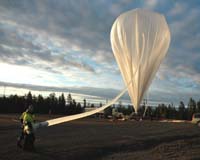
Scientists successfully launched a giant balloon with the scientific instrument AESOP aboard last week from the SSC launch facility at Esrange Space Center. The 300-meter-long balloon and flight train rose up like a gigantic golden bubble lightened by the midnight sun.
The purpose of this long duration flight is to study positron abundance in cosmic ray electrons to determine the extent to which the large scale structure of the heliospheric magnetic field is important in the transmission of galactic cosmic rays through the galaxy.
This very impressive launch was performed by the experienced American balloon launch team from NASA's Columbia Scientific Balloon Facility (CSBF) with support by the SSC launch team at Esrange.
The balloon is now floating at an altitude of 41.5 kilometers (25.7 miles) and has expanded to 1.2 million cubic meters in volume. The balloon at float altitude is 140 meters (455 feet) in diameter. It has just left the Norwegian coast heading for Greenland or Canada where it is planned to land in 4-6 days. The landing spot depends on wind direction and for how long the flight will last.
"We are very pleased with the flight so far. The launch was perfect, the balloon is at float altitude, and the science instrument is performing flawlessly", said David Pierce, NASA Balloon Programs office chief.
"The operation would not have been possible without the outstanding people and facilities at Esrange. It is always a pleasure for us to come here. It is our favorite launch site. Esrange and CSBF personnel work very well together in doing world class science on balloons." said Danny Ball, CSBF site manager.
The next flight will be the engineering test flight of a new balloon type under development called ULDB (Ultra-Long Duration Balloon vehicle). The final test will be done Saturday and the launch will take place when the weather is right once again.
The third flight during this balloon campaign will take place around June 21, when the TRACER instrument, a cosmic ray astronomy experiment from the University of Chicago, will begin its trip from Sweden to Canada in near space.
