
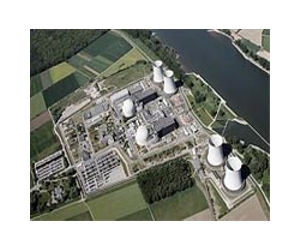
The German government is considering auctioning off allowances to extend the lifespan of the country's nuclear reactors.
Germany's Financial Times Deutschland newspaper Tuesday reported that Berlin is mulling such a plan, which observers say is aimed at filling the state coffers with much-needed cash.
It would enable the country's utilities to bid at auctions for licenses to keep their nuclear power plants running beyond previously agreed deadlines.
"It's an interesting proposal that deserves serious consideration," Environment Minister Norbert Roettgen told the business daily.
The German government in 2000 auctioned off its 3G cell phone licenses, a move that handed Berlin some $70 billion in cash. The government is eager to replicate such a success as it is trying to consolidate the national budget and pay off debt.
While officials from Chancellor Angela Merkel's government have lauded the idea, opposition politicians have complained that Berlin with a sale of licenses to the highest bidders would compromise national security.
Merkel's government for the past months has lengthily debated whether to extend the lifetime of Germany's 17 nuclear reactors, scheduled to go offline by the end of 2020.
The government has said it will unveil its overall energy strategy and a final decision on the lifeline of the country's nuclear power plants this or next month.
Individual proposals have ranged from sticking to the 2020 deadline, as envisaged under a phase-out law drafted by a former government, to extending their lifetime by as much as 28 years.
Other measures proposed include a tax on fuel rods that is aimed at compensating for the costs of nuclear waste disposal, which could hand Berlin an estimated $2.75 billion per year.
Nuclear power is still a hot potato issue in Germany. The plan to scrap the nuclear phase-out has sparked significant opposition with political and public players. More than 120,000 people demonstrated against the controversial energy source in April, forming a human chain that stretched 75 miles through northern Germany.
Germany's utilities are wary of the delay, not knowing where and when to invest.
They have recently been focusing on Britain's emerging nuclear market. Eon and RWE have decided to team up to build nuclear power plants there, promising to invest around $25 billion in the endeavor.
In Germany, the utilities have Merkel on their side.
Taking into account environmental, economic and sustainability aspects, it's obvious that Germany's nuclear power plants, "will have to run longer than until 2020," Merkel said earlier this year in Berlin.
Share This Article With Planet Earth
