
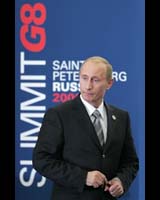
Germany will use its turn at the helm of the G8 next year to try to promote increased dialogue with the world's newer economic players and reward African nations for good governance, officials said on Wednesday. Brazil, China, India, Mexico and South Africa will be invited to the Group of Eight summit in the Baltic Sea resort of Heiligendamm June 6-8 to discuss issues such as the counterfeiting of products, rules governing working conditions, and the fight against global warming.
The other themes of the German presidency, which starts on January 1, will be the transparency of financial markets and how to increase the efficient use of energy.
The initiative to promote good governance in Africa builds on the efforts led by Britain during its G8 presidency in 2005 to cancel 40 billion dollars (32 billion euros) of debt owed by 18 of the world's poorest countries, mostly in Africa.
At the Heiligendamm summit, Germany will propose a "new partnership" with Africa, officials told journalists on condition of anonymity.
"The basic argument is that we need a new and stable framework for investment in Africa," an official said. That would include good governance, taking up the fight against corruption and the responsible use of raw materials.
Countries putting such procedures into action would be rewarded with partnership agreements that could include business deals.
German Cooperation Minister Heidemarie Wieczorek-Zeul is planning an African development conference in Germany, probably in May, and a handful of African leaders will be invited to the G8 summit.
Berlin is keen to put the issue of the fight against AIDS back on the G8 agenda as well.
Turning to other issues, Chancellor Angela Merkel wants to revisit hedge funds, which her predecessor Gerhard Schroeder tried unsuccessfully to bring under increased control at the G8 summit in Gleneagles, Scotland last year.
The speculative funds are subject to little direct regulation, since most of are headquartered in offshore financial havens and critics argue that such instruments can cause repeated surges in oil prices.
However, Germany acknowledges that hopes of a solution on hedge funds "are not high" in the face of the opposition to the idea displayed by Britain and the United States at Gleneagles.
The G8 comprises the seven most industrialised nations — Britain, Canada, France, Germany, Italy, Japan and the United States, plus Russia.
Officials said Merkel had no intention of incorporating China into the G8, where German wants to preserve the "community of values", although they stopped short of saying that China did not share the same values.
For the first six months of the year, Germany will combine its G8 role with the presidency of the European Union.
Source: Agence France-Presse
