
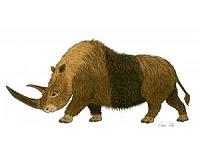
New genomic analysis suggests the decline of the wooly rhinos across ancient Siberia was triggered by climate change, not by overhunting.
Scientists collected and sequenced DNA samples from the frozen remains of 14 well-preserved woolly rhinoceros specimens. Their analysis, detailed this week in the journal Current Biology, showed their population size and genetic diversity was stable in the lead-up to their demise.
Researchers used to think humans showed up in northeastern Siberia just 15,000 years ago, but scientists have since discovered evidence of human habitation dating to 30,000 years ago.
"The decline towards extinction of the woolly rhinoceros doesn't coincide so much with the first appearance of humans in the region," senior study author Love Dalén, a professor of evolutionary genetics at the Center for Palaeogenetics, a joint venture between Stockholm University and the Swedish Museum of Natural History, said in a news release. "If anything, we actually see something looking a bit like an increase in population size during this period."
Dalén and his colleagues collected DNA from tissue, bone and hair samples from wooly rhinos. The data helped researchers measure genetic diversity and gauge the health of ancient populations.
"We examined changes in population size and estimated inbreeding," said co-first author Nicolas Dussex, a postdoctoral researcher at the Center for Palaeogenetics. "We found that after an increase in population size at the start of a cold period some 29,000 years ago, the woolly rhino population size remained constant and that at this time, inbreeding was low."
The data showed the size and health of wooly rhino populations remained stable for thousands of years after the arrival of humans. The decline of the region's megafauna more closely aligns with the rise in temperatures in the region.
The new genomic analysis also showed that like wooly mammoths, wooly rhinos had several genetic mutations that allowed them to adapt to Siberia's frigid environs.
"We're coming away from the idea of humans taking over everything as soon as they come into an environment, and instead elucidating the role of climate in megafaunal extinctions," said co-first author Edana Lord, a doctoral student at the Center for Palaeogenetics. "Although we can't rule out human involvement, we suggest that the woolly rhinoceros' extinction was more likely related to climate."
To get a more precise understanding of the extinction of wooly rhinos and other larger herbivores, researchers hope to collect DNA from rhinos that lived and died closer to when Siberia's megafauna began their rapid decline, around 14,000 years ago.
