
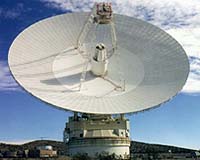
The U.S. Government Accountability Office announced Monday that although NASA's Deep Space Network can meet most requirements of its current communications workload, it may not be able to meet near-term and future demand, thereby leaving open the possibility of disruptions and outright losses of data.
"The system – suffering from an aging, fragile infrastructure with some crucial components over 40 years old – has lost science data during routine operations and critical events," the GAO – formerly the General Accounting Office – said in a report.
"The potential for more significant system failure and major disruption to the deep space exploration program, both manned and unmanned, looms large if nothing is done to address the condition of the DSN," the report continued.
The GAO is an independent agency that responds to requests by Congress to evaluate the effectiveness of federal government programs and policies.
"In addition, new (space missions) find they must compete for this limited capacity, not just with each other, but also with legacy missions extended past their lifetimes, such as NASA's Voyager, that nonetheless return valuable science."
GAO investigators said DSN officials doubt they can provide adequate coverage to a looming increase in mission customers, "especially if they increase dramatically under the President's Vision (for Space Exploration)."
The GAO found that NASA does not attempt to match its funding requests for space communications capacity with its space communications requirements, because control over those requirements and funding remains with the mission directorates and programs themselves – something investigators called a "disconnect (that) allows programs to invest in capabilities that may undercut agency-wide goals for space communications."
Because of the investigation, the GAO report said, NASA has begun to study how to manage the gap between its space-communications requirements and its communications funding, but has not yet issued any recommendations.
The report, meanwhile, recommends that NASA direct the DSN to "(1) identify total program requirements for deep space communications capabilities for the near and long term, in terms better defined than the single coverage commitment of 95 percent, (2) determine the extent to which the program's current capabilities can support those identified requirements and (3) develop a plan to address any gap between those capabilities and requirements and identify the estimated costs of any enhancements needed."
