
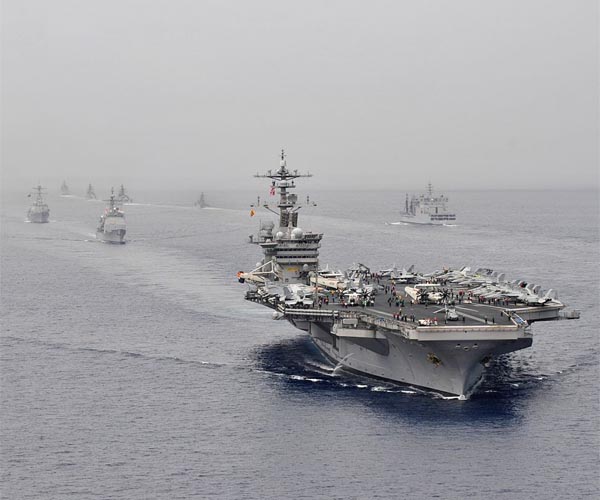
The U.S. Navy fleet, with a current target of 355 ships by 2030, could increase to more than 500 ships, documents supporting the Future Navy Force Study indicate.
Two analyses sent to Defense Secretary Mark Esper suggest that between 480 and 534 total ships should be at sea, including manned and unmanned vessels. Last week, Esper referred to a future Navy of "over 350 ships" in an address to the Rand Corp.
He noted that China intends to complete a modernization of its armed forces by 2035, and is investing in cost-effective, autonomous and unmanned long-range submarines to counter American naval power.
"I want to make clear that China cannot match the United States when it comes to naval power," Esper said. "Even if we stopped building new ships, it would take the PRC [People's Republic of China] years to close the gap when it comes to our capability on the high seas.
"In short, it will be a balanced force of over 355 ships, both manned and unmanned, and will be built in a relevant timeframe and budget-informed manner."
The Navy's current goal of 355 ships is part of a 2016 Force Structure Assessment conducted by that branch in 2016. Reference to a Navy funding request for 42 new ships by Fiscal Year 2025 was included in a 130-page report to Congress last week by the Congressional Research Service.
The Future Navy Force Study documents suggest that the Navy seeks more but smaller ships, fewer aircraft carriers and additional unmanned vessels ships and submarines.
The 35 percent increase in the fleet, from the planned 355 by 2030, marks a shift in how the Defense Department regards the Navy's future.
USS Delbert Black commissioned at private ceremony
Washington DC (UPI) Sep 25, 2020 –
The USS Delbert Black was commissioned at Port Canaveral in Florida on Saturday.
The ceremony was private, with a small number of in-person guests and speakers, due to COVID-19. But it was livestreamed, with some Navy and political leaders delivering remarks remotely.
Those attending in person included Ima Black, widow of Delbert Black, the Navy's first Master Chief Petty Officer and the ship's namesake, and James Geurts, the Navy's assistant secretary of research, development and acquisition.
Speakers praised the ship's namesake, who oversaw the creation of the Master Chief Petty Officer of the Navy during the Vietnam War and guided the branch through that era.
Russel L. Smith, the Navy's current MCPON, was the principal speaker, and several of Black's successors delivered remarks virtually via video chat.
"Every sailor should know and appreciate the role MCPON Black played in elevating the role of and the appreciation for enlisted leadership. Much of the respect you and your selfless service receive today is a direct result of Del overcoming monumental hurdles, including outright rejection in some quarters, to establish the MCPON office and the hard work of subsequent MCPONs who carried what he began forward," James L. Herdt, the ninth master chief petty officer of the Navy, said in a virtual address.
Herdt said subsequent MCPONs have all "felt MCPON Black's hand on our shoulder" in their roles.
Sen. Rick Scott, R-Fla., also joined the ceremony remotely.
"Master Chief Black went above and beyond to serve our nation and this is a well-deserved honor," Scott said.
The USS Delbert Black, which is configured as an Arleigh Burke-class, Flight IIA destroyer, sustained an estimated $31 million in damage after a 2019 collision, completed sea trials in March and builder's trials in February after undergoing repairs.
