
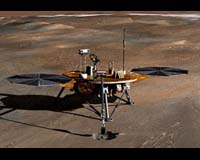
Phoenix Mars Mission Principal Investigator Peter Smith will unveil a full-scale Mars lander this Friday at a VIP celebration at the Phoenix Mars Mission Science Operations Center in Tucson. University of Arizona engineers will use the mock lander on its Mars-looking platform to test instruments and commands. Scientists will practice operations in the "PIT" (Payload Interoperability Testbed), where the lander resides, before performing them for real on Mars.
Guests at Friday's event will see the a demonstration of the lander's robotic arm and a replica of the Mars landscape, view a new animation of the mission's landing and science operations and hear from the UA President Robert Shelton, lead scientist Peter Smith and Lunar and Planetary Laboratory Director Michael Drake.
The Phoenix Mars Mission Center in Tucson will be the base of science operations for NASA's next mission to the Red Planet. The Phoenix Mars Lander will be launched in August 2007 for a May 2008 touchdown. After the NASA Jet Propulsion Laboratory in Pasadena, Calif., flies the spacecraft to Mars and verifies that the landed spacecraft is healthy, NASA will turn mission control over to UA in Tucson.
The UA is the first university ever to lead a mission to Mars.
Phoenix will be the first lander ever to dig beneath Martian polar surface in search of water ice, clues to climate change and habitat that might support life.
The payload includes a nearly eight-foot long robotic arm for digging down through soil into ice, a robotic arm camera, a surface stereo camera, a descent camera, a meteorological station, a high-temperature furnace and mass spectrometer, a powerful atomic force microscope and a miniature wet chemistry laboratory.
The $385 million Phoenix Mission is the first mission in NASA's "Scout" program. UA leads the mission with project management at NASA's Jet Propulsion Laboratory and development partnership with Lockheed Martin Space Systems. International contributions for Phoenix are provided by the Canadian Space Agency, the University of Neuchatel (Switzerland), the University of Copenhagen and the Max Planck Institute in Germany.
Members of the public interested in seeing the lander and touring the Phoenix Mars Mission's Science Operations Center can do so during the open house scheduled for Saturday, Oct. 21 from 10 a.m. to 4 p.m.
