
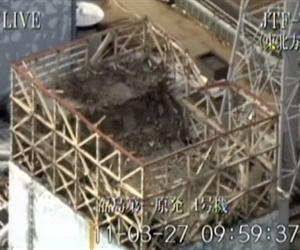
The operator of Japan's stricken nuclear plant said Sunday it will send two remote-controlled robots into a reactor building damaged by a hydrogen explosion to gauge radiation and temperature levels.
Emergency workers battling to stabilise the plant after a massive earthquake and tsunami knocked out cooling systems on March 11 have not been able to enter any of the reactor buildings since the disaster.
The explosion — one of several caused when a build-up of hydrogen reacted with oxygen in the atmosphere in the days immediately after the quake — blew the roof off the outer structure housing reactor three.
A spokesman for the Tokyo Electric Power Co. (TEPCO) said the two American-made robots would enter the reactor three building on Sunday to check radiation, temperature, humidity and oxygen levels.
Radiation from the overheating reactors has made its way into the air, land and sea, leading the government to impose exclusion zones around the plant in Fukushima prefecture and damaging local fishing and farming industries.
The news came as Yukio Edano, the right-hand man of Japan's prime minister, made his first visit to Fukushima, where he met local officials and emergency workers.
Edano, who is also Japan's top government spokesman, said the safety of people in the area was Tokyo's main priority, as new data indicated highly radioactive water may still be leaking into the sea from a nuclear plant.
"The government will place the highest priority on the safety of local residents," he told reporters in Fukushima city.
Edano also said TEPCO was "in the final stage" of coming up with a detailed strategy for solving the world's worst nuclear crisis since Chernobyl, adding it would be made public soon.
Japan's Prime Minister has said bringing the situation at the plant under control was his "top priority" and pledged to "maintain transparency" over the crisis.
"We continue to make the utmost efforts to address the issue of outflow of radioactive water from the plant into the ocean," Naoto Kan added in an article published in the International Herald Tribune newspaper Saturday.
His comments came as TEPCO said levels of radioactive iodine-131 in the sea near reactor number 2 had risen to 6,500 times the legal limit on Friday, up from 1,100 times on Thursday.
TEPCO said earlier it had managed to plug a leak of radioactive water from a cracked pit into the ocean and was checking for any more water runoffs from the plant.
The company has also been forced to empty containers with lower-level radioactive water into the ocean, sparking protests from local fishermen and concern in neighbouring countries.
earlier related report
Australia downgrades Tokyo travel warning
Sydney (AFP) April 17, 2011 –
Australia has eased its travel warning for Tokyo, more than a month after a magnitude 9.0 quake and tsunami hit Japan's north, damaging nuclear power facilities and triggering fears of a meltdown.
Australia lowered the warning for Tokyo after the UN World Tourism Organisation Friday said there was no reason to avoid Japan as radiation levels at the nation's airports and ports were well within safe limits.
"The level of advice for Tokyo and surrounding areas has been lowered to high degree of caution," the advisory said in the advice released late Friday.
Australia's overall advice for Japan urges travellers to exercise a "high degree of caution" — the third of five levels of warning which range from the lowest of 'be alert to your own security' to the highest of 'do not travel'.
Citizens are still advised to avoid the Ibaraki, Tochigi, Iwate, Miyagi and Fukushima prefectures, including an exclusion zone around the damaged Fukushima Daiichi nuclear plant.
Australian airline Qantas has also announced it will resume direct services to Tokyo on April 19 — rather than operating its Narita services via Hong Kong.
In the days after the March 11 disaster, Qantas said it was maintaining its scheduled flights to Japan but its crews were overnighting in Hong Kong rather than the Japanese capital because of aftershocks and damage to infrastructure.
Share This Article With Planet Earth
