
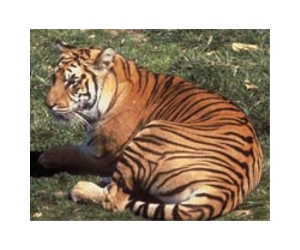
Thai police on Wednesday discovered the frozen body parts of several tigers and other big cats thought to be destined for buyers in Vietnam and China in a raid on a suburban Bangkok house.
Two men, one Thai and one Vietnamese, were arrested after police found a freezer containing the parts of at least three tigers, one panther and a wild cat.
"From our initial interrogation, they said they planned to send the animal parts to a Vietnamese buyer waiting in Laos, but the final destinations are in Vietnam and China," said Police Colonel Apichart Sirisith, Crime Suppression Deputy Commander.
The two suspects face 10 years in prison if convicted on charges relating to the illegal possession of wildlife.
Thailand, a hub of international smuggling, is one of just 13 countries which host tiger populations. Worldwide, tiger numbers are estimated to have fallen to only 3,200 from approximately 100,000 a century ago.
In March Thai authorities seized more than 200 live animals, including tigers and lions among other rare species, in a raid on an illegal wildlife supplier.
Police said that operation was part of a global network importing protected animals from countries in Africa and elsewhere and breeding them for illegal sale.
Last month Thai police officers caught four men in the act of chopping up a tiger in a Bangkok house. Elephant, zebra, wildebeest and lion remains were also found at the suburban property.
S.Africa seizes 10 rhino horns from Vietnamese home
Johannesburg (AFP) May 16, 2012 –
Ten rhino horns were seized overnight from the home of a Vietnamese man outside Johannesburg, where they were hidden in the wardrobe and in cupboards, police said Wednesday.
"We found 10 rhino horns and an elephant tusk" after raiding the home based on a tip off, spokesman Vishnu Naidoo said.
He declined to identify the man beyond his nationality.
"He was apparently involved in criminal activities because we found other passports, travel documents and five million rand ($600,000, 469,000 euros) in cash, including US dollars," Naidoo told AFP.
"The horns were lying loose, obviously hidden in the wardrobe and cupboards," he added.
Rhino horns are prized in Asian traditional medicine, with Vietnam emerging as a major market based on belief that they can cure cancer. The horns have no scientific value in medicine.
But the soaring demand has driven poaching to record levels in South Africa, home to most of the world's remaining rhinos. More than 200 rhinos have been killed so far this year.
