
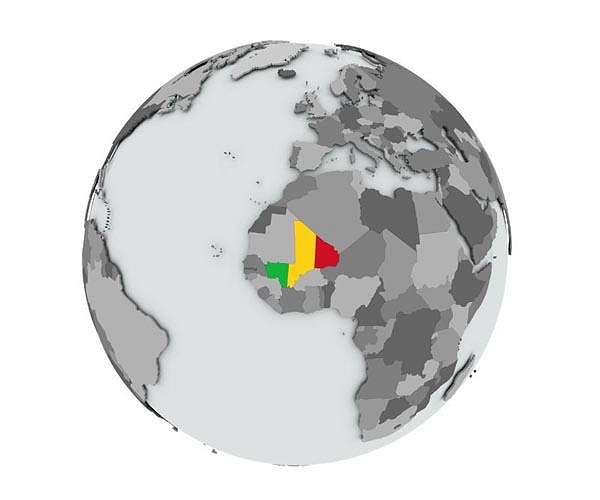
Key ministers from France and Niger met on Friday as French forces revamp their mission in the Sahel following a planned pullout from Mali.
Foreign Minister Catherine Colonna and Defence Minister Sebastien Lecornu arrived in the Nigerien capital late Thursday.
They held talks on Friday with Foreign Minister Hassoumi Massoudou and Defence Minister Alkassoum Indatou, followed by President Mohamed Bazoum.
The visit takes place as French forces complete a pullout from Mali, placing the spotlight on Niger as a frontline state in the fight against jihadism, and as the unstable region struggles with a string of military coups.
"We are here to show France's commitment, at the side of the Nigerien government," Colonna told a joint press conference.
"We are here to respond as best we can to the needs you put forward."
Niger, a deeply poor former French colony, is the focus of a French push that hopes to stem jihadism through security as well as development.
It is one of the biggest recipients of French aid, receiving 143 million euros (dollars) last year.
The two sides on Friday signed agreements for a French loan of 50 million euros and a grant of 20 million euros.
France will also increase food aid to Niger by 66 percent this year, to eight million euros, "at a difficult time for world food security" because of the war in Ukraine, Colonna said.
"If we don't win the war of development, we will eventually lose the war against terrorism," Massoudou said.
The French ministers were also to visit a base at Ouallam, north of Niamey, which oversees joint operations on Niger's western border by several hundred French and Nigerien troops.
Colonna returns to Paris late Friday, while Lecornu heads to Ivory Coast, for talks with President Alassane Ouattara and a visit to French troops there.
– Sahel problems –
Niger, the world's poorest country by the benchmark of the UN's Human Development Index, has been badly hit by the jihadist insurgency that began in northern Mali in 2012 and then swept across neighbouring countries.
Thousands of civilians have been killed and more than two million have fled their homes.
Niger itself is facing insurgencies both on its western border with Mali and Burkina Faso as well as its south-eastern frontier with Nigeria.
It hosts tens of thousands of internally displaced people, as well as refugees from Burkina Faso, Mali and Nigeria.
French forces who have been supporting Mali for nearly a decade are expected to complete their pullout in the coming weeks after France and the Malian junta fell out.
The roots of the dispute lie in a military takeover in August 2020, which was followed by a second coup in May 2021.
Friction developed over the junta's delays in restoring civilian rule and escalated when Mali brought in Russian paramilitaries — personnel described by France as "mercenaries" from the pro-Kremlin Wagner group.
Coups followed in Guinea last September and in Burkina Faso in January.
– French in Africa –
At its peak, France's Barkhane mission had 5,100 troops among five Sahel allies, all former French colonies — Burkina Faso, Chad, Mali, Mauritania and Niger.
The forces have provided key support in air power, troop transport and reconnaissance. In Niger, France notably has an air base at Niamey where it has deployed drones.
After the Malian pullout, the mission will have "around 2,500" troops, Barkhane commander General Laurent Michon said in an interview this month.
The reconfigured mission will emphasise "more cooperative operations," in which French forces will act in support of local armies rather than in place of them, he said.
More than a thousand troops will be deployed in Niger, providing air support and training, French sources say.
French troops are also in Gabon, Ivory Coast and Senegal, as well as in the east of Africa in Djibouti.
On Wednesday, French President Emmanuel Macon said he had asked the government and military chiefs to "to rethink our overall presence on the African continent by the autumn".
He called for "a presence that is less static and less exposed" and "a closer relationship" with African armed forces.
French army interventions in Africa
Abidjan (AFP) July 15, 2022 –
France is in the final phase of a pullout from Mali, where it sent troops in 2013 to help the former colony fight a jihadist-backed insurgency.
Here is a snapshot of the major French interventions in Africa since the great wave of French decolonisations in 1960.
France has deployed forces to the continent more than three dozen times. The interventions have overwhelmingly concerned former French colonies, either in a solo capacity in the declared aim of protecting civilians, under bilateral defence agreements or in joint operations alongside African, Western or UN troops.
– Sahel –
In 2013, France launched Operation Serval to drive out jihadist groups who had joined a regional insurrection in northern Mali the previous year.
Serval was replaced in 2014 by a wider anti-jihadist mission, Operation Barkhane, in Chad, Burkina Faso, Mali, Mauritania and Niger.
Barkhane is now withdrawing from Mali after France fell out with the country's ruling junta, which has forged ties with the Kremlin.
Under Macron's orders, the massive pullout should be completed by summer's end.
By then, Barkhane, which counted 5,100 personnel in the Sahel at its peak, will have "around 2,500" in the region, th operation's commander General Laurent Michon said in an interview this month.
Of these, more than 1,000 will be in Niger, providing air support and training, French sources say.
French forces in the Sahel will henceforth play more of a support role, helping local militaries, rather than act in their place, Michon said.
– Central African Republic (CAR) –
In 1979 France staged Operation Barracuda during which Emperor Jean-Bedel Bokassa, at the time in Libya, was overthrown by French paratroopers.
In 1996-1997 the country was rocked by three successive mutinies. France launched Operation Almandin to provide security for foreigners and evacuate 1,600 people.
In 2006 and 2007 Paris intervened to support CAR troops fighting rebels in the northeast.
In 2013, after the ouster of president Francois Bozize, a bloody civil conflict erupted along sectarian lines. France had a UN go-ahead to send more than 1,000 troops to stabilise CAR. The operation, named Sangaris, was wound up in October 2016 after elections.
– Ivory Coast –
In 2002, France launched Operation Licorne (Unicorn) to protect foreigners after the country plunged into unrest. Licorne was reconfigured as a rapid reaction force in support of a UN mission.
In 2011, French troops played a key role in forcing out President Laurent Gbagbo, whose refusal to concede defeat to Alassane Ouattara in elections the previous year sparked a conflict that claimed several thousand lives.
– Chad –
From 1968-1972, French troops helped the government against a rebellion in the Tibesti region.
In 1983 France launched Operation Manta at the request of President Hissein Habre after a Libyan incursion.
– Zaire (Democratic Republic of Congo) –
In 1978, at the request of the Kinshasa government, 600 French and 1,000 Belgian paratroopers landed on Kolwezi to rescue 2,700 European expatriates from rebels in Shaba.
In 2003 an EU peacekeeping force under French command and called Artemis, quelled a deadly, long-running feud between the Lendu and Hema communities which claimed tens of thousands of lives in the east of the country.
– Comoros –
In 1989, French troops intervened after the assassination of president Ahmed Abdallah in a coup led by the notorious French mercenary Bob Denard.
In 1995 France's Operation Azalee foiled another coup led by Denard.
– Rwanda –
Under its Noroit operation from 1990 to 1993, France sent up to 600 troops to the northwest following an offensive by Ugandan-based rebels from the mainly Tutsi Rwandan Patriotic Front (RPF), now in power.
In 1994, some 500 French paratroopers evacuated more than 1,000 French citizens and foreigners after the death of Rwanda's Hutu president Juvenal Habyarimana and the start of the genocide which left some 800,000 dead, mostly Tutsis.
From June to August 1994 France carried out Operation Turquoise, a military operation in Rwanda with humanitarian aims.
acm-fm-eab-jmy/ri/bp
