
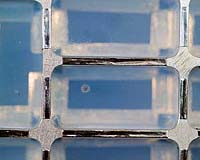
Returning to Earth last weekend after a seven-year, three-billion mile journey through space, Stardust's Sample Return Canister has now arrived at NASA's Johnson Space Center, in Houston.
In a special laboratory, a team of scientists at JSC will begin work to open the container and analyze the comet and interstellar dust samples.
An internet webcam is providing live views of the scientists' work on the canister.
The particles will be distributed to several laboratories around the
world, including nine in France, reports CNES, including the Institute
for Space Astrophysics and Paris' Museum of Natural History, who will be allowed to carry out preliminary tests on the samples to get a clearer picture of just what was collected.
There will then be an open call for research propositions with only the best being selected. Working together, the laboratories in France will study the chemical composition of the microscopic particles using the Synchrotron X-ray source in Grenoble, France. They also plan on testing the particles to find if they contain any organic material or traces of water. Isotopic analyses and mass spectrometry will also be carried out.
For these interstellar particles the French government acquired a NanoSims 50, a type of chemical microscope / ionic probe, still very rare in the scientific community.
Scientists are hoping that these analyses will help answer some of the questions that still remain on the original material that made up our universe and the formation of the planets.
