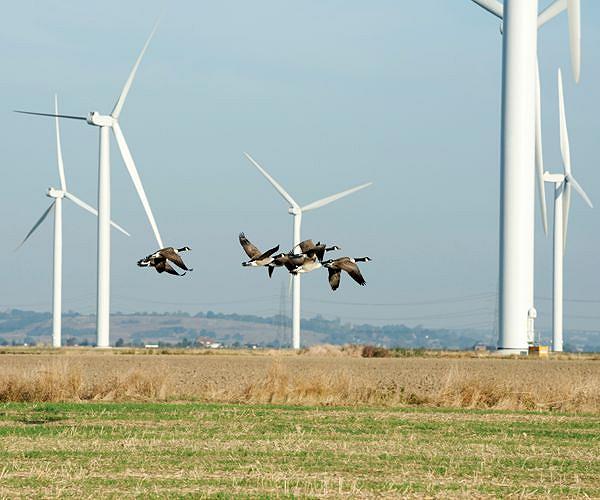
Wind farms pose a variety of threats to birds, including some of the world's most iconic avian predators — like the golden eagle, the world's most widely distributed eagle.
According to a new study, published Wednesday in the journal Ibis, the risk of collision posed by a turbine's giant, spinning blades depends on the availability of suitable golden eagle habitat inside and outside the confines of a wind farm.
Surprisingly, scientists found habitat loss is the preeminent threat posed by wind farms in Scotland, not collision itself.
For the study, scientists analyzed GPS data from 59 tagged golden eagles before and after the construction and operation of 80 wind farms across Scotland.
"Previous research on Golden Eagles, notably in the United States, has tended towards collision with turbine blades as the main consequence of their interaction with wind farms," corresponding author Philip Whitfield said in a press release.
"Our study shows that across numerous wind farms in Scotland, this was not the case, but that deleterious habitat loss through avoidance of turbines was the main impact," said Whitfield, an ornithologist and wind farm expert with the consulting group Natural Research.
The actual construction of wind farms can, of course, disrupt suitable eagle habitat, but the latest research suggest eagles simply stop using suitable habitat when new neighboring wind farms begin operations.
"We proffer that understanding why avoidance or collision in large raptors may occur can be conceptually envisaged via variation in fear of humans as the 'super predator' with turbines as cues to this life-threatening agent," researchers wrote in their new paper.
In the future, scientists hope to investigate different ways turbines could be arranged or operated in order to minimize their impact on habitat suitability and eagle behavior.
Previous studies have shown sensors can help warn turbines about birds at risk of collision.
Globally, golden eagles are not considered vulnerable or threatened. When considering the impacts of the green energy infrastructure, costs and benefits must be weighed.
As multiple studies have shown, climate change is a much bigger threat to birds than turbines, an essential tool in the fight to reduce greenhouse gas emissions and slow rising temperatures.