
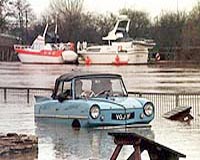
Heavy rains triggered floods in parts of northern England on Saturday, forcing the evacuation of hundreds of homes and the deployment of army personnel to shore up overwhelmed defences.
Lancashire in northwest England and Yorkshire in the northeast were the worst affected, with environment officials issuing more than 300 alerts in those areas, including 31 warnings of possible deadly floods.
The Met Office national weather service issued its most serious "red warning", which calls on those in areas at risk to take action.
Around 10,000 homes in the region were without power after a substation was damaged, and many elderly and other vulnerable people were rescued from inundated homes by lifeboat.
In some areas water reached the lower windows of houses and shops, turning high streets into muddy waterways, and cars were abandoned after narrow country lanes turned into fast-flowing streams.
Underscoring the severity of the deluge, Prime Minister David Cameron is expected to visit the flood-hit region on Monday after chairing an emergency government COBRA committee meeting on Sunday.
An emergency meeting had also been held on Christmas Day.
"My thoughts are with people whose homes have been flooded. I'll chair a COBRA call tomorrow to ensure everything is being done to help," Cameron tweeted.
Officials are under pressure after similar flooding earlier this month in northwest England.
The floods in Cumbria caused damage estimated at hundreds of millions of pounds and turned many towns and villages into swamps, prompting angry accusations that the government had failed to spend enough on flood defences.
More than 160,000 evacuated in deadly LatAm floods
Asuncion (AFP) Dec 26, 2015 – More than 160,000 people have been driven from their homes in Paraguay, Argentina, Brazil and Uruguay in some of the worst floods in decades, which have left at least six people dead, authorities said Saturday.
The areas hardest hit in the week leading up to Christmas were in Paraguay, where four people have been killed by falling trees. President Horacio Cartes has declared a state of emergency to free up more than $3.5 million in disaster funds.
The intense rain storms, caused by an unusually strong "El Nino" pattern, have forced 130,000 Paraguayans from their homes, authorities said. In the capital Asuncion, thousands were temporarily without power.
Emergency personnel were carrying out rescue and evacuation operations, said David Arellano, the head of operations for the National Emergency Secretariat (SEN).
"We cannot abandon the thousands of families who each year are affected by flooding," Cartes said in his Christmas message.
El Nino is the name given to a weather pattern associated with a sustained period of warming in the central and eastern tropical Pacific that can spark deadly and costly climate extremes.
Last month, the UN's World Meteorological Organization warned the phenomenon was the worst in more than 15 years, and one of the strongest since 1950.
In northeastern Argentina, two people were killed and about 20,000 were evacuated from their homes by flooding caused by a rise in the level of the Uruguay River, authorities said.
Entre Rios province was the worst off with about 10,000 people displaced, most of them in Concordia, a city of some 170,000 located on the banks of the river where officials said it was the most serious flooding in 50 years.
Uruguay, which borders the river, has declared a state of emergency in several northern departments. As of Saturday, about 9,000 people were forced from their homes, according to national emergency officials.
And in Brazil, President Dilma Rousseff on Saturday flew by helicopter to survey the damage in southern Rio Grande do Sul state, where about 9,000 people have been displaced by flooding in recent days.
The federal government has released $1.7 million in emergency funds for the affected areas.
