
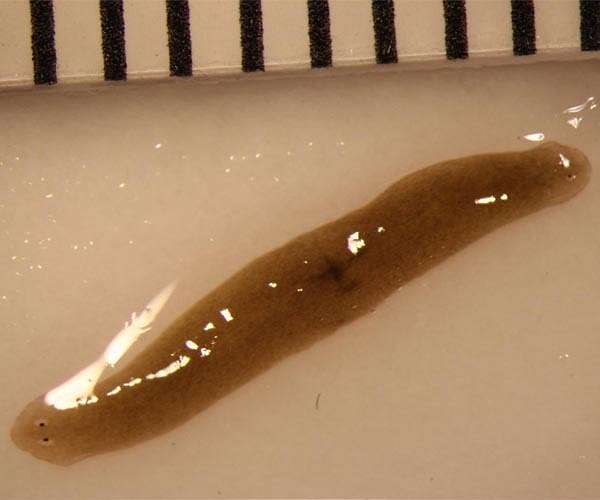
Flatworms known as planaria could soon replace rabbits and other animals as reliable test models for topical skin products, according to a new study.
The use of rabbits and other animals for product testing has long raised questions of ethics and sustainability. Human skin cells in a petri dish are sometimes used as an alternative, but the medium isn't a reliable proxy for living tissue.
The new research, published Thursday in the journal Toxicology in Vitro, showed free-living flatworms offer a closer approximation of interactions between potential skin products and living skin.
The epidermal membrane that forms the outer layer of flatworms is very similar to human skin, researchers said.
"Developing more ethical alternatives to tests that others do on rabbits, known as the Draize test, has been a major challenge, especially in relation to evaluating products for sensitive human tissue," study author Vitaliy Khutoryanskiy said in a news release.
"Our tests with flatworms show that there are potential ways to screen skin irritants in a more ethically responsible way," said Khutoryanskiy, a professor of formulation science at the University of Reading in Britain.
By mixing fluorescent dye with potential skin product and exposing flatworms to it, researchers were able to observe how products are absorbed across different tissue layers.
When exposed to known human skin irritants, researchers found significant amounts of fluorescent dye penetrated the outer skin layers of the planaria.
"While the vast majority of cosmetic skin products are no longer tested on animals, it remains critical that new developments for clinical treatments are tested robustly and we hope that we can find solutions that consign the Draize test to history," Khutoryanskiy said.
"We also hope to continue planaria research and develop further tests for probe irritation potential of chemicals to other human tissues," he said.
