
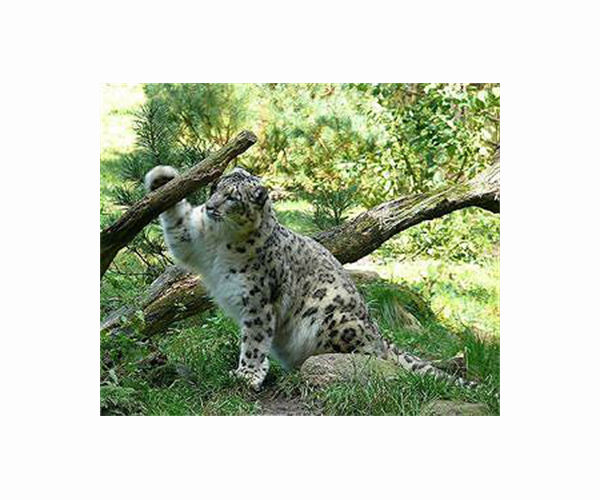
The world is a stressful place these days, especially for snow leopards.
Environmental stressors, like rising temperatures, disappearing glaciers and poaching, can negatively impact snow leopard health.
To monitor the hormonal stress levels of snow leopards, scientists in Japan developed a new method for analyzing snow leopard fecal samples.
The new method — described Wednesday in the journal Methods in Ecology and Evolution — can be performed quickly and easily in the field.
"Because conventional hormone monitoring methods require frozen and refrigerated chemical reagents, and laboratory equipment, it is almost impossible to use them on-site." lead study author Kodzue Kinoshita, researcher at Kyoto University, said in a press release.
To perform the new hormonal analysis method, scientists collect a snow leopard's fecal samples, place it in a container with ethanol and shake the container by hand. Researchers then dip test strips into the solution.
After exposure, hormonal concentrations trapped on the test strips are analyzed using a smart phone application.
The process relies on immunochromatography, the same hormonal analysis technology used in pregnancy tests.
Researchers tested the accuracy of the new technology using fecal samples from captive snow leopards at Kohu Yuki Zoo, Asahikawa City Asahiyama Zoo and Nagoya Higashiyama Zoo and Botanical Gardens in Japan.
Because environmental stressors can depress reproductive success, it's helpful for conservation scientists to be able to track hormonal changes in snow leopard populations.
Snow leopards are listed as "vulnerable" by the International Union for Conservation of Nature.
Over the last several decades, warming temperatures have shrunk the snow leopard's range, which is mainly among the mountains of Central and South Asia.
The feline predators are also threatened by poachers, as well as farmers who sometimes carry out retaliatory killings for livestock attacks.
"Simple methods like this, will allow researchers, rangers and zookeepers, to quickly and easily assess the stress status of snow leopards." said Kinoshita. "Getting this insight will be useful for the management of animal welfare and conservation planning."
The researchers suggest their new test could be adapted to analyze hormonal changes in a variety of species, both captive and wild animals.
"As a next step, I would like to apply this method to various other animals and make it more reliable." said Kinoshita. "I would also like to apply it to not only wild animals, but also to zoo animals and pets to clarify the stress of these animals and improve their living environment."
