
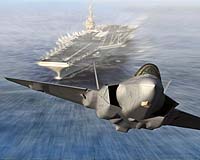
The carrier variant of the F-35C Lightning II Joint Strike Fighter has successfully completed the first phase of developmental testing at sea.
The U.S. Navy said two F-35s aboard the USS Nimitz logged a total of 39.2 flight hours, conducted 124 catapults, 222 touch-and-go landings, and 124 arrestments.
There were no unintentional hook-down bolters, or missed attempts to catch an arresting wire on the flight deck and 100 percent of threshold test points were achieved.
The Navy said the successful landings underscored a re-design of the aircraft's tailhook by Lockheed Martin and Fokker Technologies of the Netherlands following issues that arose during land-based testing.
Spurred on by the performance of the two planes, the team tested their performance of night operations, something typically conducted in a later phase of testing, the Navy said.
"We had such confidence in how the plane is flying that we lowered the weather minimums to what the fleet is actually using, knowing that when I lower my hook and come into the groove I'm going to trap," said Lt. Cmdr. Ted Dyckman, Navy test pilot. "That says a lot for the airplane. So, when it came time for night traps (landings), we said the plane is ready and we launched it."
The F-35C is expected to be deployed by the Navy beginning in 2018.
