
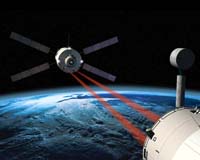
The European Space Agency on Thursday announced the latest in a long series of delays in the maiden launch of a robot craft designed to resupply the International Space Station. The "Jules Verne", which ESA had previously hoped to launch in the last quarter of 2007, will now lift off "not earlier than mid-January 2008," the agency said in a press release.
The unmanned craft, billed as the most sophisticated automated spacecraft ever made, was originally pencilled for launch in late 2004.
But this schedule was scrubbed by the loss of the US space shuttle Columbia in February 2003, which had a knock-on effect on the ISS's construction programme.
The Jules Verne, named after the 19th-century French writer, is the first so-called Automated Transfer Vehicle (ATV).
Launched by an Ariane-5 rocket from ESA's base in Kourou, French Guiana, it is designed to dock with the ISS, delivering 7.5 tonnes of food, water, pressurised air, fuel and experiments.
Its engines can also reboost the station's orbit to overcome the effects of lingering atmospheric drag.
After six months, the vehicle undocks, bearing station waste, and then burns up in a controlled re-entry over the Pacific Ocean.
In its press release, ESA said the new delay was caused by launcher availability and pre-launch inspection procedures as well as "heavy traffic" at the ISS towards the end of the year.
The ISS construction programme has had to be heavily modified after the loss of Columbia and the cautious resumption of flights by the remaining three US shuttles.
earlier related report
Assessment of ESA's ATV mission readiness results in a new launch window
