
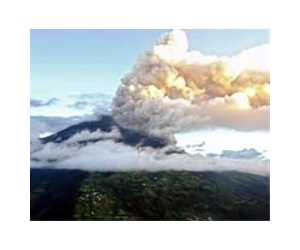
Authorities in Ecuador downgraded a warning late Saturday on a possible major eruption of the Tungurahua volcano.
The alert status was reduced from the maximum red to orange as activity eased, the national civil defense office said.
The Geophysical Institute in Quito earlier reported since early Saturday a "very rapid and sustained increase in seismic activity and other manifestations at the surface" of the volcano.
The red alert then had been issued around midday Saturday.
Tungurahua, which has been erupting off and on since 1999, spewed incandescent material and ash, according to the institute.
A red alert for some hours was in effect in Banos and other Andean villages near the 5,029-meter (16,500-foot) volcano, whose name means "throat of fire" in the local Quechua language. It is located some 135 kilometers (85 miles) south of Quito.
In 1999, the 15,000 inhabitants of this town were forcibly evacuated by a powerful eruption and were unable to return to their homes for a year.
Banos, one of the gateways to the Amazon jungle, hosts an average of a million tourists a year, 40 percent of them foreigners, according to local officials.
Tungurahua's biggest eruption, in August 2006, left six people dead and destroyed hundreds of homes.
earlier related report
Indonesia downgrades Mount Merapi volcano alert
Yogyakarta (AFP) Dec 3, 2010 –
Indonesian scientists Friday downgraded the alert status of Mount Merapi from its highest level after it killed more than 350 people in a series of violent eruptions that started in late October.
"The decision was taken this morning at 9:00 am (0200GMT) as its eruption activities continue to slow down," the head of the volcanology office, Subandrio, told AFP from a monitoring office in Yogyakarta, the main city south of Merapi.
He said that more than 250,000 people who had been living in evacuation shelters were now allowed to return home, except for those who lived in the worst affected district, Sleman, on the southern slope.
"The volcano's threat is now limited to only some parts on the southern slope. People are not allowed to do activities there."
Another volcanologist, Surono, said people must remain away from river banks due to possible fast-moving volcanic mudflow streaming down the volcano's slope during heavy downpours.
"It's especially during the heavy rainfall as the eruptions left an estimated 150 million cubic metres of volcanic material on the slopes," he said.
Hundreds of people fled their houses earlier this week when heavy rainfall flushed thousands of tons of volcanic material into several rivers, damaging a bridge and submerging houses.
Disaster management officials said they had recorded 353 people killed. Many were buried under fast-flowing torrents of boiling hot gas and rock that incinerated villages on the southern slopes when the volcano exploded on November 5, its biggest eruption in over a century.
The volcano, located on the central island of Java, killed around 1,300 people in 1930 but experts say the latest eruptions are its biggest since 1872.
Share This Article With Planet Earth
