
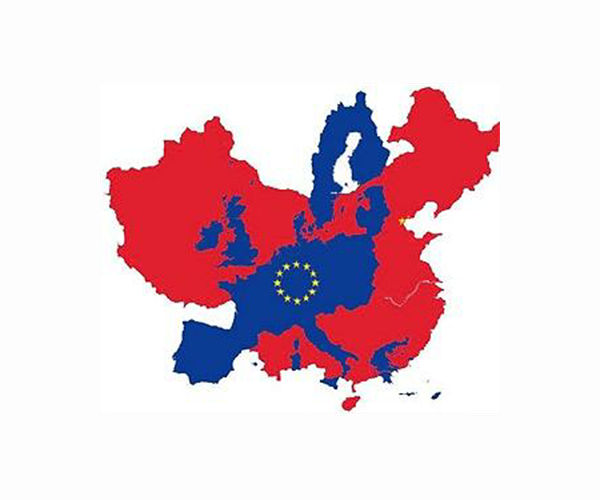
The European Commission said Tuesday that efforts to win approval for the EU's massive investment deal with China were effectively "suspended" given the soured diplomatic relations between both sides after tit-for-tat sanctions.
"We now in a sense have suspended… political outreach activities from the European Commission side," EU Executive Vice President Valdis Dombrovskis told AFP in an interview.
"It's clear in the current situation with the EU sanctions in place against China and Chinese counter sanctions in place, including against members of European Parliament (that) the environment is not conducive for ratification of the agreement," Dombrovskis said.
Trying to ratify the deal "will depend really on how broader EU-China relations will evolve", he added.
To the surprise of many, the European Union and China in late December approved a major investment pact, wrapping up seven years of painstaking negotiations thanks to a final push by Germany.
The pact has been defended as a much needed opening to China's long-closed economy for European companies, but was sure to face a difficult ratification amongst the 27 member states as well as the European Parliament.
Dombrovskis, a former Latvian prime minister, is in charge of spearheading that approval process in the EU, which has already met with pushback from key MEPs.
The European Union sanctioned four Chinese officials in March over suspected human rights violations in China's far western region of Xinjiang.
China responded by imposing its own sanctions against European politicians, scholars and research groups.
G7 seeks common front on China in first talks since pandemic
London (AFP) May 4, 2021 –
The Group of Seven wealthy democracies on Tuesday discussed how to form a common front towards an increasingly assertive China in the foreign ministers' first in-person talks in two years.
Backing US President Joe Biden's calls for a deeper alliance of democracies, host Britain invited guests including India, South Korea and Australia for parts of the talks in central London stretched out over three days.
The foreign ministers welcomed one another with Covid-friendly elbow-bumps and minimal staff as they gathered at Lancaster House, a West End mansion, for a day largely devoted to China — whose growing military and economic clout and willingness to exert its influence have increasingly unnerved Western democracies.
"It is not our purpose to try to contain China or to hold China down," said US Secretary of State Antony Blinken, who also met Tuesday with British Prime Minister Boris Johnson.
"What we are trying to do is to uphold the international rules-based order that our countries have invested so much in over so many decades to the benefit, I would argue, not just of our own citizens, but of people around the world — including, by the way, China," Blinken told reporters Monday.
A senior US official said after Tuesday's session that there had been "no real disagreement of any meaning" within the G7 on China or other issues.
The ministers all voiced alarm about China's human rights record, amid outrage over the mass incarceration of Uyghur Muslims, as well as on Beijing's "coercive" economic policies towards other nations, the official told reporters.
The official said the talks were less about coordinating action than finding a common front to bring "like-minded" countries on board.
The European Commission on Tuesday suspended efforts to approve a massive EU investment deal with China, news sure to be welcome in the United States, although officials said it did not come up in G7 discussions.
– Cooperation where possible –
British Foreign Secretary Dominic Raab called for "holding Beijing to the commitments that they've made", including on Hong Kong, which was promised a separate system before London handed over the colony in 1997.
But in line with the Biden administration, which has shifted the tone if not substance of former president Donald Trump's hawkish stance on China, Raab also called for "finding constructive ways to work with China in a sensible and positive manner where that's possible" — including on climate change.
"We want to see China stepping up to the plate and playing its full role," Raab said.
One of Blinken's predecessors as secretary of state, Hillary Clinton, said democracies needed to "put tremendous pressure on China in the court of public opinion".
"I believe that it's imperative that not just the Biden administration but all of our alliances, join together in making certain demands of China," she told the Chatham House international affairs think tank in London.
The G7 foreign ministers also discussed the spiralling crisis in Myanmar as well as Syria, Afghanistan, Libya and wide concerns on Russia.
Blinken will head on Wednesday to Ukraine in a show of support after Russia last month amassed and then pulled back 100,000 troops in border regions and Crimea.
– Return of diplomacy –
The Group of Seven is preparing for a leaders' summit next month in Cornwall, southwest England, in what will be Biden's first foreign trip as president.
The US official said that Britain is planning a second foreign ministers' meeting later in the year of the Group of Seven, which also includes Canada, France, Germany, Italy and Japan.
The second meeting will feature the inclusion of African nations in a bid to bring more focus to issues on the continent, the official said.
Britain has also announced that the G7 finance ministers will meet for the first time in person since the pandemic on June 4 and 5, again at Lancaster house.
EU foreign policy chief Josep Borrell welcomed the return of in-person diplomacy.
"In video conference you just read a paper. There is no interactivity," Borrell said.
With in-person talks, "it's the way you forge consensus; this is the way you forge agreements".
