
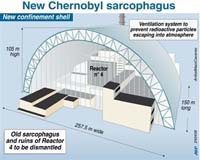
The European Bank for Reconstruction and Development agreed Monday to help finance a new protective covering around the Chernobyl reactor, the scene of the world's worst nuclear accident.
The bank said it would pay 135 million euros (215 million dollars), or ten percent of its 2007 profits, to a global fund to help pay for a new concrete sarcophagus around the still highly radioactive reactor core.
"EBRD governors today agreed to a donation … to support international efforts to clean up the site of the Chernobyl nuclear power plant," it said in a statement on the last day of its annual meeting in the Ukrainian capital.
"The EBRD contribution is a further step in the efforts by the international community to make the Chernobyl site safe."
The sarcophagus, which should be ready by 2012, was estimated to cost 1.3 billion euros in total, according to the bank.
On April 26, 1986, reactor number four at the Chernobyl nuclear power plant exploded, contaminating large parts of western Europe and Ukraine, Belarus and Russia, then all part of the Soviet Union.
The current sarcophagus, resembling a huge concrete shield, stands over the ruins of the reactor in the heart of a 30-kilometer-radius (18.6-mile) exclusion zone and was built in the immediate aftermath of the accident to confine radioactive leaks.
Huge steel girders were later added to prop up the sarcophagus's foundations and outer walls.
The planned new construction, measuring 190 metres (623 feet) wide and 200 metres long, will resemble a half-cylinder and slide over the existing sarcophagus. The steel structure will weigh 18,000 tonnes — more than twice the Eiffel tower.
