
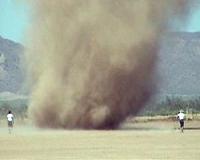
New research suggests the particles lifted into the air by dust devils, tornado-like whirlwinds found on Earth and Mars, can remain suspended in the atmosphere for long periods of time.
The findings, detailed in the journal Astrobiology, could help scientists better understand weather and atmospheric phenomena on Earth and Mars.
Planetary scientists have long observed dust devils tracking across Mars' dry, red surface, and many hypothesized the whirlwinds provide much of the dust circulating through the Red Planet's atmosphere. But measuring dust devils on Mars isn't easy.
Luckily, dust devils on Earth look and behave much the same way.
To better understand Martian dust devils, researchers measured the dust devil grain sizes at different heights, tracked the paths and patterns left in the dirt and analyzed the phenomena's meteorological qualities.
Researchers held long vertical rods with sticky tape in front of the paths of dust devils to collect grains at different heights.
"We hold the boom upright in the path of a dust devil and wait until the dust devil passes over the boom," said Jan Raack, researcher at Open University at the European Planetary Science Congress, said in a news release. "Numerous grains are collected on the sticky tape, which are preserved on-site by pressing sections of the tape from different heights onto glass slides."
Scientists took the collected grains back to the lab and probed them for insights into the mechanics of dust devils.
"We found that the dust devils we measured have a very similar structure, despite different strengths and dimensions," Raack said. "The size distribution of particles within the dust devils seems to correspond to the distribution of grain sizes in the surface they passed over."
While larger particles are lifted just a few feet off the ground, researchers found as much as 70 percent of the fine dust particles picked up by dust devils remain suspended. These particles can be transported across the globe by high altitude winds. They can also negatively affect the environment and human health, as well as alter weather.
Ship exhaust helps grow bigger ocean thunderstorms
The fumes emitted by the engines of large cargo ships and tankers are encouraging bigger, more intense oceanic thunder storms.
When researchers mapped and analyzed global storm patterns, they found the largest storms tended to form above two the busiest shipping channels.
Further analysis showed lightening strikes are twice as likely to occur above shipping lanes in the Indian Oc … read more
