
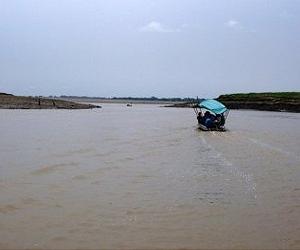
A severe drought parching northern Brazil this year has shrunk the mighty Amazon River — the world's longest river — to its lowest level in 47 years, officials said Wednesday.
The waterway's depth at Manaus, the main city in the Amazon region, was just 19.34 meters (63.45 feet) — well below its average of 23.25 meters (76.28 feet), the country's Geological Service told AFP.
The last time the river was at such a low level was in 1963.
Scientists say it appears Brazil is headed for its worst drought since that year. Final data to be collected up to October were expected to confirm that.
The withering of the Amazon has produced unusual scenes of children playing football in the dried-up riverbed of a tributary, the Quarenta, that crosses Manaus.
Worse, seven remote towns upstream that rely on water traffic as their main link to civilization have been cut off as their own tributary has all but disappeared.
"There are towns inaccessible by foot, and we need helicopters," the mayor of one of the towns told the Folha de Sao Paulo newspaper.
Some residents who lived through the 1963 drought said they were not so hard up this time, as they have mineral water and water trucks available.
"The drought is affecting river traffic, but today we can take a plane if we have to," said resident Joao Texeira, 74.
earlier related report
Brazil launches plan to save bio-rich savannah
Brasilia (AFP) Sept 15, 2010 –
Brazil on Wednesday launched a new plan to save its immense savannah, an expanse of wild, bio-rich grassland at risk from encroaching farmland, by boosting spot checks and sustainable development.
The government said it would invest 200 million dollars over the next two years to preserve the zone, known as the Cerrado, in the same way as it has slowed deforestation of its Amazon jungle.
"We are talking of an ecosystem that represents five percent of the world's biodiversity," Environment Minister Izabella Teixeira said.
The savannah, which comprises forests, marshlands and grassy plains covers an area four times the size of France.
Nearly half its vegetation has been lost, however, to farmers and ranchers, creating a massive output of carbon dioxide, a greenhouse gas.
"Everything indicates that in the last two years carbon dioxide emissions in the Cerrado have been bigger than those from the Amazon forest, because of greater deforestation," Roberto Smeraldi, the head of an environmental group called Amigos da Terra Amazonia, told AFP.
Denise Hamu, the chief of the Brazilian branch of the WWF international environmental group, said: "For the first time, the Brazilian government is putting its attention on the Cerrado, which is of vital importance because its ecosystem forms the transition with the Amazon forest."
Share This Article With Planet Earth
