
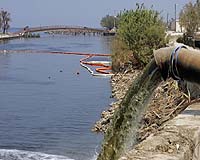
The US Army Corps of Engineers is pumping floodwaters out of New Orleans at a faster pace than anticipated and should finish draining the city by October 2, the head of the corps said Thursday.
But engineers assessing the system of levees protecting the city have discovered additional breaches and it is not yet clear how vulnerable it remains in the wake of Hurricane Katrina, said Lieutenant General Carl Strock.
"As decisions are made to move back into these parishes, we need to understand the level of vulnerability our citizens have moving back in," he told reporters.
Strock said 20 percent of the city's pumping stations have come back online, allowing flooded areas to be drained more quickly than previously anticipated.
With no new storms threatening New Orleans, engineers also have widened breaches that had been opened deliberately to allow water to flow out of the city into Lake Pontchartrain, he said.
Floodwaters in Chalmette and St. Bernard Parish are expected to be drained by September 20, the Chalmette extension and east New Orleans by September 30, and the downtown area that includes the French Quarter by October 2, he said.
"These are all accelerated over previous estimates. So we are very encouraged by that," Strock said.
The general said at least nine breaches have been identified in the levee system, including in a natural wildlife reserve east of the city and in Plaquemines County, south and east of the city.
The major breaks detected earlier in the levees facing Lake Pontchartrain at 17th Street and the London Avenue canal have been repaired, and work is underway to repair those in Plaquemines, an important corridor to supply oil fields.
"No water is currently flowing into New Orleans from any breach site, but we have to get those back in place so we understand the level of protection that is still there," Strock said.
"That will be an important consideration when the parish president or the mayor makes the decision of when to move back in," he added.
Longer term, the Corps of Engineers will study what will be required to make the levee system capable of withstanding another category four or five hurricane like Katrina.
But he said the study itself will take years, and rebuilding the levee system will take even longer. The current system was authorized in 1965, but work on it was held up for 10 years by litigation.
Levees are built in layers. Engineers must allow each layer to settle for four to five years before adding a new one.
"You can't put them all down at one time because you can have catastrophic results in the foundation," Strock said. "So these things don't happen overnight."
On another front, the general said the intracoastal waterway that runs from Texas to Florida is now open to east west ship traffic to full depth.
He said the corps created a bypass to get around the blocked New Orleans inner harbor.
Along the ravaged Gulf coast, the port of Mobile is open without restrictions, he said. Pascagoula, Biloxi and Gulfport were open with restrictions.
related report
New Orleans Vulnerable Until Levees Rebuilt For Next Year: Army
Baton Rouge Sept 15 (AFP) – New Orleans' levees will be rebuilt in time for next year's hurricane season, but in the meantime the city remains vulnerable to further flooding, army engineers said Thursday.
Many of the levees collapsed when Hurricane Katrina hit the Gulf Coast more than two weeks ago – a catastrophic breach of the last lines of New Orleans' flood defences that left swathes of the city under water.
"Right now the level of protection in many of the areas is just like there wasn't a levy there," director Dan Hitchings of the US Army Corps of Engineers told journalists in the Louisiana state capital Baton Rouge.
"Any storm surge will enter back into those areas," he said, adding: "We're getting some minimal level of protection… but right now, don't fool yourself, there isn't any significant level of protection."
"If we had a storm, the water would reenter those areas," he added.
Hitchings said that while the issue was "a concern," army engineers were working around the clock to close up breaches in the levee system.
He said that teams were currently on schedule to have the defensive levees rebuilt by June 2006 in time for the start of the hurricane season.
Hitchings added that pumping water from the stricken city had slowed in recent days as the putrid floodwaters have receded, uncovering a sludge-covered mess of debris from smashed houses, cars, downed trees and corpses.
The pumping rate was down to some 9,790 cubic feet (277 cubic metres) per second – around a 13 percent drop on the rate it was being pumped out one week ago, but still the equivalent of around 375 Olympic swimming pools an hour.
He said an unseasonable lack of rain and getting pumps online faster than expected also explained why the city would be drained earlier than initially estimated. Most of the floodwaters should be pumped out by early October.
