
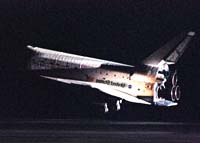
The US space shuttle Discovery landed at the Kennedy Space Center here Monday, completing its eight-day mission to repair the Hubble telescope, NASA said.
The shuttle and its seven-member crew touched down at 7:01 p.m. (0001 GMT Tuesday) in the night's dark sky, about two hours behind schedule.
The US space agency earlier postponed the shuttle's afternoon landing due to strong winds over Florida. The end of the eight-day mission had originally been scheduled for 5:24 p.m. (2224 GMT).
"We have crosswinds above the acceptable limit for the shuttle set at 15 knots," National Aeronautics and Space Administration spokeswoman Eileen Hawley said earlier Monday.
NASA had two other landing options after the first postponement — at 7:01 p.m. (0001 GMT Tuesday) and the other at 8:43 p.m. (0143 GMT Tuesday).
The National Aeronautics and Space Administration also could have switched landing sites. But as space commander Curt Brown had said earlier, "I think I can speak for the whole space program: we'd rather have Kennedy Space Center as our prime landing site."
Commander Brown and co-pilot Scott Kelly began procedures on Sunday to bring Discovery back to earth, descending to an orbit slightly lower than the 612 kilometers (382 miles) at which it had been previously positioned. They also carried out final flight systems checks.
Except for the retro-rockets used for its descent, the shuttle does not have engines for the landing and had to glide into the five-kilometer (three-mile) long runway at the space center after a dive at Mach 29 from the atmosphere.
During three spacewalks lasting longer than eight hours each, American astronauts Steve Smith, John Grunsfeld, Michael Foale and their Swiss colleague Claude Nicollier completed a series of repairs to the Hubble telescope which had not been functioning properly since mid-November.
The 10-year-old Hubble, which allows scientists to peer deep into space, had received six new gyroscopes, a new on-board computer, six voltage-temperature improvement kits and a refurbished fine guidance sensor.
New thermal protective covers will allow the Hubble to better cope with temperature fluctuations since one side of the telescope faces the Sun continually, cooling when it goes behind the Earth from a steamy 80 degrees Celsius (175 degrees Fahrenheit) to a frigid minus 54 (minus 65 Fahrenheit) — a range of more than 130 degrees (266 Fahrenheit).
It should resume its operations in two to three weeks, according to John Campbell, director of the Hubble program at NASA's Goddard Space Center in Greenbelt, Maryland.
NASA cut short the Discovery mission by two days to make sure it could land in time for its crew and ground technicians to complete their post-flight analyses by December 31 in order to avoid possible Y2K computer problems.
The successful landing allowed NASA to end the year on a positive note despite the agency's recent failures, including the Mars Polar Lander which failed to send a signal back to earth.
