
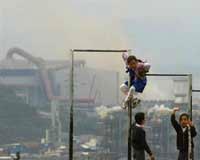
With its blast furnaces, vats of chemical refuse and fetid stream, this town about 100 kilometers (63 miles) east of Istanbul is a symbol of Turkey's uncontrolled industrialization. No less than 170 plants and factories that are a kaleidoscope of all of Turkey's toxic industries have settled in the heart of Dilovasi, chasing the town's 50,000 inhabitants into the surrounding hills — but not far enough to flee the pollution.
"Linen that is white in the morning is black with filth at night," complained resident Mehmet Umit. "Even on a clear day, when evening comes, the valley is blanketed with clouds and smog."
"When you take the kids outside for sports, they perform well below par because they can't breathe," noted Ali Osman Tok, a physical education teacher at a Dilovasi elementary school.
He blamed the widespread asthma and chronic bronchitis his youthful wards suffer from on the factory funnels that belch out toxic fumes around the clock.
It is an image Turkey that could do without as the European Union prepares to release a crucial progress report Wednesday on the full membership negotiations begun in October 2005 between Ankara and Brussels.
The report is expected to be highly critical of Turkey's efforts to bring itself level with European norms in a variety of fields, and protection of the environment, one of 35 chapters on review, is unlikely to be a winner.
The Turkish authorities are aware of the gravity of the situation and in late October, an ad hoc parliamentary committee issued an alarming report.
Committee members noted that "most industries in Dilovasi use or produce carcinogenic products" without taking any protective measures.
They called on the government to declare the region a "sanitary disaster area" and simply evacuate two of the most exposed neighborhoods in town.
"While the world average for mortality due to cancer is 12 percent, the rate is 30 percent in Dilovasi," noted another report, drawn up by a physician at the nearby University of Kocaeli.
"People having resided in Dilovasi for 10 years or more are 4.5 times more likely to die of cancer than those who have lived there for less," the report said.
Another constant, visual and olfactory reminder of the endemic pollution is Dilderesi, the once-picturesque stream that runs through town.
"When I was a kid, I used to swim in there, the water was clean," reminisced architect Alparslan Artut, 34, a member of an environmental protection association. "Now, most of the factories dump their waste in it."
Dilderesi alone, Artut said, "is responsible for 40 percent of the pollution in the Gulf of Izmit," the easternmost projection of the Sea of Marmara into Turkey's industrial heartland.
Mayor Musa Kahraman too complained in an interview of the uncontrolled growth of industry in Dilovasi, a boom town built around industries that flourished to feed, among others, the already saturated, 16-million-plus megalopolis of Istanbul.
But he said the West should be more understanding toward Turkey and its environmental problems.
"Europe took 150 years to build its industrial society," he said. "We went through the same process in fast-forward mode, in just 20 years."
Osman Pepe, the minister of the environment responsible for a new, harsher law enacted in April against industrial pollution, estimated the cost of bringing Turkish industry up to European environmental norms at a whopping 35 billion euros (44.5 billion dollars).
He too said Europe must be patient.
"We must educate our industrialists, our lawmakers and our politicians to become environmentally responsible," he told AFP, "and that will take time."
Source: Agence France-Presse
