
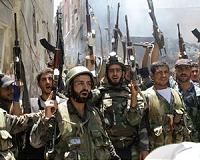
Air strikes killed dozens of civilians in Eastern Ghouta on Friday and forced thousands more to flee, as Syrian troops pressed their blistering assault on the last rebel stronghold near Damascus.
The latest deaths brought the toll for the nearly month-old offensive to 1,364, with world powers still unable to stop one of the devastating conflict's worst crises.
Syria's war enters its eighth year with another deadly assault also unfolding in the north, where Turkish-led forces pressed an operation to seize the Kurdish-majority region of Afrin.
The operation has sent thousands onto the roads, with bombing of the city of Afrin on Friday killing 43 civilians, a third of them killed in a deadly strike on a hospital.
On the edge of Ghouta, a sprawling semi-rural area within mortar range of central Damascus, more than 2,400 civilians streamed out of destroyed towns, carrying scant belongings in bags and bundles.
Crowds crammed into a government centre on the edge of Eastern Ghouta on Friday, unsure what the next step would be after walking straight into the arms of the forces that have relentlessly pounded their homes for weeks.
– Exodus –
"We were afraid of leaving — they had told us the army would arrest us," said 35-year-old Abu Khaled, who used to run a retail clothing shop in Ghouta.
"We reached the army and didn't find that, but now we're basically living in a camp," he told AFP.
Syria's envoy to the UN Bashar al-Jaafari said 40,000 people fled Ghouta on Thursday, and the sudden exodus appeared to have caught the government flat-footed.
Long lines formed outside the public bathrooms, and displaced families complained of a lack of access to water or mattresses.
The Syrian army in a message broadcast on state television urged all residents to use "corridors" it had established to leave the enclave, saying it had recaptured 70 percent of rebel territory.
The ground offensive pressed by Syrian troops and allied militia has splintered Eastern Ghouta into three pockets, each held by a different faction.
Those three Islamist groups said Friday they would be willing to negotiate directly with Russia on a ceasefire for Ghouta, but did not mention talks with the Syrian government.
Their statement came hours after UN special envoy for Syria Staffan de Mistura said talks were ongoing between Russia and one of the groups, Jaish al-Islam.
That negotiations track had already produced six days of calm for Ghouta's largest town of Douma, he said.
Douma has also seen deliveries of food, and hundreds of civilians have been bussed out as part of medical evacuations.
– Hospital bombed –
The Syrian Observatory for Human Rights said at least 96 civilians were killed in Russian and regime air strikes on the southwestern Ghouta pocket on Friday.
The Observatory says it determines whose planes carry out raids according to type, location, flight patterns and munitions used, but Russia on Friday denied its jets were taking part in the Ghouta operation.
The heaviest of Friday's raids were on Kafr Batna, where at least 70 civilians died and where the Observatory said incendiary weapons were used.
A reporter in the town contributing to AFP saw eight charred bodies in the streets and said wounded people were left in the roads as rescue centres had been put out of service by bombing.
Syrian President Bashar al-Assad has in recent months recovered swathes of territory lost at the beginning of the conflict and Ghouta was one of his key remaining targets.
An exodus of similar proportions was under way hundreds of kilometres (miles) to the north in the city of Afrin, where Kurdish forces have been nearly encircled by Turkish troops.
The Observatory said Thursday more than 30,000 people had fled the city in 24 hours, and another 15,000 escaped on Friday, fearing a siege.
The monitor said a Turkish strike on Friday hit Afrin's hospital, killing 16 civilians, including two pregnant women.
"There was bombing on the city during the day that got close to the hospital, but this evening it was directly hit," Serwan Bery, co-chair of the Kurdish Red Crescent, told AFP.
"It was the only functioning hospital in Afrin city," he said.
The deadly strike brought to 43 the number of civilians killed in the town on Friday, the Observatory said.
Turkey's military denied hitting the hospital, saying on Twitter that its operation in Afrin "is carried out in such a way as to not cause any harm to civilians."
The UN said it was worried the forces staying inside were not allowing civilians to flee, as that would leave them more exposed to Turkey's superior firepower.
Ravina Shamdasani, spokesperson for the UN's Rights Office decried "reports that civilians are being prevented from leaving Afrin city by Kurdish forces … (and) are being held to be used as human shields."
Tearful reunions, uncertain fates for Syrians fleeing Ghouta
Hosh Nasri, Syria (AFP) March 16, 2018 –
Syrian soldier Ayman al-Khatib scoured the crowds streaming out of Eastern Ghouta until he spotted his parents. Falling to his knees, he embraced them for the first time in seven years.
A year after the young fighter left his hometown in 2011 for compulsory military service, Ghouta fell to rebels — putting Khatib and his parents on opposite sides of one of Syria's most ferocious battlefronts.
"We were separated for too long. Today, I got my soul back by seeing him again," said Khatib's 51-year-old father Zakariya, after the emotional reunion.
Zakariya and the rest of the Khatib family were among around 2,000 people who fled Ghouta on Friday through a "safe corridor" leading into government-held territory.
Tens of thousands are estimated to have fled Ghouta, using two access routes carved out by the Syrian army as part of its assault on the one-time opposition bastion on the outskirts of the capital.
"My joy today is two-fold — the first is that I saw my son after long years of yearning," said Zakariya, clutching Khatib's face with both hands and checking it for any scars or wounds from fighting.
"The second joy is that I left oppression, injustice, and hunger."
The towns, villages, and lush agricultural fields that make up Eastern Ghouta were home to around 400,000 residents, but had been sealed off from nearby Damascus since 2013.
With all roads closed, Khatib was not able to attend the funeral of his brother, killed two years ago in the violence ravaging the suburb.
– Loved ones still inside –
Since February 18, the government's air and ground assault has recaptured 70 percent of Ghouta, and Khatib was battling alongside the troops as they pressed into his own hometown.
"I was flustered, there was a pit in my heart. On the one hand, I was scared for my parents. On the other, I wanted to do my duty," he said.
On Thursday, he managed to contact his family, who said they would try to flee their battered neighbourhood the following day.
"I looked for them in the massive crowds until I found them. I was like a thirsty man in the desert who finally found water," Khatib said.
Setting aside his rifle and grinning, he picked up three of his youngest relatives, born in Zabdin after he left and whom he had never met.
Similar reunions were taking place all along the dusty roadside, where displaced families were awaiting buses to take them to temporary shelters in Damascus.
Waving away food and bread, 60-year-old Zahraa Nasser sobbed uncontrollably on her nephew's shoulders, also an army fighter.
"He recognised me before I knew him — his face has changed so much," said Nasser.
Just like Khatib, Aref Awad had left his hometown in Ghouta to serve out his compulsory military service in 2011, just as Syria's war was breaking out.
"Today, I'm getting a sense of the value of my participation in the battles," Awad told AFP.
"My aunt was freed, but I still have loved ones inside," he said.
– 'We lost seven years' –
Syria's ambassador to the United Nations, Bashar al-Jaafari, said 40,000 people had escaped on Thursday alone.
The influx has overwhelmed the temporary shelters set up on the edges of Damascus by Syrian authorities, who were bracing themselves Friday for new numbers.
"There will be a lot of new people arriving today. We're trying to get new places to shelter them and bring them basic services," said Ratib Adas, deputy governor of Damascus province.
In Adra, a government-held quarter north of Ghouta, some 3,000 displaced people were being hosted in a school-turned-shelter.
Some water and food had been distributed, but many had spent the night sleeping on the floor and long lines formed at the public bathrooms.
"We spent 27 days living in terror, fear, under bombing," said Yassin, a 35-year-old man who fled Hammuriyeh.
The recapture of his hometown this week by Syrian troops had allowed authorities to open up their second and much larger "corridor" for residents to flee.
Yassin was relieved to leave the bombing behind, but feared an uncertain future for him and his four children.
"I want to work to feed my family. I don't need someone to feed me," he told AFP.
"We lost seven years of our lives. We want to start afresh. But can we? No."
