
A form of the mysterious material known as dark matter could have helped to ignite the first stars in the universe.
German and U.S. scientists said if dark matter is made of a strain of low-mass particles called sterile neutrinos – whose decay accelerates the formation of molecular hydrogen – they could have caused the first stars to form as early as 20-million years after the Big Bang.
The light from those first stars could have been sufficient to ionize interstellar gas between 150-million and 400-million years after the Big Bang, rendering the universe transparent to electromagnetic radiation, including visible light.
The scientists – Peter Biermann at the Max Planck Institute for Radio Astronomy, and Alexander Kusenko at the University of California, Los Angeles – said they have conducted neutrino-oscillation experiments that suggest the existence of right-handed or "sterile" neutrinos. These particles cannot interact with visible matter directly, but they can interact by mixing with conventional neutrinos.
The number of sterile neutrinos is not known, but if each one has mass of a few thousand electron volts, equivalent to about 1 millionth of the mass of a single hydrogen atom, they could account for dark matter – the missing mass that comprises about 20 percent of the universe.
This new hypothesis could explain several astronomical mysteries, Biermann and Kusenko said. For example, their calculations show that sterile neutrinos could have been produced in the Big Bang in sufficient amounts to account for dark matter.
Also, the particles could explain the longstanding puzzle of pulsar velocities. Pulsars, or rapidly rotating neutron stars, emerge from supernova explosions preferentially in one direction at velocities as high as hundreds of kilometers per second – sometimes more than 1,000 kilometers (640 miles) per second.
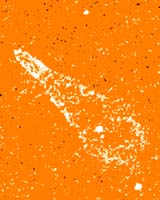
To date, the origin of such high velocities remains unknown, but the scientists said sterile neutrino emissions could explain the pulsar kicks – such as one such pulsar is exhibiting within a stellar formation called the Guitar nebula.
If dark matter comprises particles that reionized the universe, Biermann and Kusenko write in the March 17 issue of Physical Review Letters, the same particles streaming from a supernova would have created the cosmic guitar.
"The formation of central galactic black holes, as well as structure on subgalactic scales, favors sterile neutrinos to account for dark matter," Biermann said. "The consensus of several indirect pieces of evidence leads one to believe that the long sought-after dark-matter particle may, indeed, be a sterile neutrino."
