
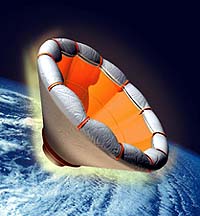
The first test worldwide of the new reentry technology IRDT (Inflatable Reentry and Descent Technology) was successfully completed say officials at DASA.
The Business Unit Space Infrastructure of DaimlerChrysler Aerospace AG (Dasa, Munich) said in Bremen on Tuesday that the "Fregat" upper stage of the Russian Soyuz rocket and a demonstrator equipped with flight-monitoring sensors landed in the Russian steppe last Wednesday at 8.59 CET.
The demonstrator is equipped with the innovative reentry technology IRDT. Search for the "Fregat" upper stage, which is also equipped with the innovative heat shield, will be continued.
Due to unfavorable weather conditions and locator transmitter failure, the recovery of the demonstrator was delayed by several days.
First inspection of the demonstrator showed that reentry was successful. No signs of burn were found on the heat shield. However, there had been deviations during the flight phase after reentry.
It appeared as if the calculated rate of fall had been exceeded so that the demonstrator was deformed on impact. The cause of increased rate of fall can only be clarified after detailed examination to be undertaken by Lavochkin in Moscow.
"This first successful test can be considered a major step towards our goal of ensuring the future reuse of space transportation systems and thus the reduction of transportation costs", said Dr. Stefan Gaul, Vice-President Orbital Systems and Operations of the Business Unit Space Infrastructure of Dasa.
The reduction of transportation costs is the decisive precondition for future scientific and economic utilization of space with reusable transportation systems being the key to this in the medium term, he continued.
The IRDT technology was developed by the Russian company Lavochkin. The outstanding feature of the innovative heat shield is its low weight. Like a liferaft used in aircraft or ships, the shield is folded up and safely stored in the space transportation system.
The IRDT will inflate shortly before reentry of atmosphere and then act as a drag parachute. As the heat shield can be launched in a small package in contrast to other reentry systems so far in use (e.g. Space Shuttle, capsules), space, weight and transportation costs can be saved.
A wealth of IRDT applications will be possible in the future, for example, automatic and considerably cost-effective transports of samples and cargos from the International Space Station back to Earth.
The Business Unit Space Infrastructure of Dasa and its Russian partner Lavochkin managed to prepare for this mission in just nine months time.
