
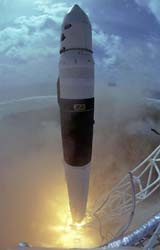
A review board said this week it has found the cause of the failed March 24 launch of the SpaceX Falcon 1 launch vehicle and has given its approval for a new attempt this fall.
The board, composed of investigators at the Defense Advanced Research Projects Agency, as well as SpaceX personnel, determined that the only plausible cause of the fire was the failure of an aluminum B-nut on the fuel pump inlet pressure transducer due to inter-granular corrosion cracking.
This failure, the board said in a statement, caused RP-1 fuel to leak onto the engine and down the outside of the thrust chamber. When the engine ignited, the leaking fuel caught fire.
The fire, over time, resulted in a loss of pneumatic pressure, causing the RP-1 and liquid oxygen pre-valves to close. The fault terminated engine thrust 34 seconds after the Falcon lifted off from Kwajalein Island – part of the Republic of the Solomons – in the South Pacific Ocean.
The board said its determination "was based on the analysis of recovered parts immediately adjacent to the failed B-nut, telemetry that showed lower than expected pressure in the fuel line near the failed B-nut (evidence of a fuel leak in that particular location), and pre-launch fuel checks that verified the integrity of the rest of the fuel system."
DARPA and SpaceX said they "plan to work together to accomplish and verify the recommended corrective actions as the launch vehicle moves toward its next planned launch."
The failed March 24 launch carried a DARPA payload, conducted under the DARPA/Air Force Falcon Small Launch Vehicle program, which is attempting to develop and demonstrate affordable private space lift capability.
The government review board was co-chaired by retired U.S. Air Force Brig. Gen. Simon P. "Pete" Worden, who also is NASA's Ames Research Center director, and retired Air Force Col. Robert L. Paulson, a private consultant.
