
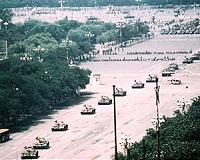
China's information blackout about the crackdown on the 1989 Tiananmen protests took a new turn on Monday: users of a popular social media app could not send each other money transfers alluding to the anniversary date.
Open discussion of the brutal crackdown is forbidden in China, where hundreds — by some estimates more than a thousand — died when the Communist Party sent tanks on June 4, 1989 to crush a student-led demonstration calling for democratic reforms.
The United States called on China on Monday to disclose how many were killed, drawing a rebuke from Beijing, which brands the protest as a "counter-revolutionary rebellion".
Foreign news broadcasts on commemoration events are usually blocked while survivors and the families of those killed are put under surveillance or forced to travel out of Beijing as the anniversary approaches. Security prevented an AFP photographer from approaching the square on Monday.
Social media is also heavily controlled, and on Monday users of the ubiquitous WeChat application were unable to exchange "red envelopes", or money packets, valued at 89.64 yuan or 64.89 yuan, indicating the date of the anniversary.
A "system busy. Try again later" message appeared every time AFP journalists tried to complete a transaction involving the sum, but the service functioned smoothly if the amount was changed, suggesting deliberate censorship.
People in China use clever tactics to circumvent censorship. When dissident Nobel laureate Liu Xiaobo died of cancer while in custody last year, people posted candle emojis as a discreet tribute. Those wanting to allude to the #MeToo movement have used emojis and the Chinese characters for rice and bunny, which are "mi" and "tu".
Chinese search engine Baidu did not yield any results for the term "29th anniversary of Tiananmen massacre" during the past week and posts on any commemoration events were missing from China's Twitter-like microblogging platform Weibo.
The Chinese government has "spent enormous amounts of resources" to enforce a "thorough and all-encompassing" erasure of information linked to the incident, William Nee, a China researcher at Amnesty International Hong Kong, told AFP.
"This year, it might be incrementally more effective, since the government has increased self-censorship on WeChat groups and has become better at using artificial intelligence to proactively ban what it deems to be problematic photos."
Tencent Holdings, which operates WeChat, could not be reached for comment.
– 'Commemorate the struggle' –
Several prominent bloggers and activists were forced to go on "vacation" under police escort ahead of the sensitive date.
Dissident democracy activist He Depu told AFP that two policemen drove him to a hotel in the Yellow Mountains, a popular tourist resort in central China, on May 31, and he will only be allowed to "checkout" on Tuesday afternoon.
Activist Hu Jia said two national guards drove him from Beijing to a hotel in the centre of Qinhuangdao, a beach resort about 300 kilometres (180 miles) east of the capital on June 1.
"This is already my 14th year of being forced to take a vacation on June 4. But, wherever I am, I fast the whole day and light candles to commemorate the struggle," he said.
"After all, I feel lucky… to be a survivor. On this day 29 years ago, the bullets flew over my head. I also feel saddened… because so many people died, but China is still stuck in 1984 in terms of (political) progress."
– US demands death toll –
Families of pro-democracy protesters killed in the 1989 bloodbath have recently written an open letter urging President Xi Jinping to acknowledge their suffering and "re-evaluate the June Fourth massacre".
The semi-autonomous territory of Hong Kong is the only place on Chinese soil where the anniversary is openly marked with a famous annual vigil that took place again on Monday.
US Secretary of State Mike Pompeo issued a statement urging China to "make a full public accounting of those killed, detained or missing" in the massacre.
Pompeo quoted Liu Xiaobo as saying: "The ghosts of June 4th have not yet been laid to rest."
China lodged a formal diplomatic protest over Pompeo's remarks.
"The Chinese government has already come to a clear conclusion regarding the political disturbances that occurred in the late 1980s," Chinese foreign ministry spokeswoman Hua Chunying said.
Pompeo's statement is "groundlessly accusing the Chinese government and interfering in China's internal affairs. The Chinese side is strongly dissatisfied and resolutely opposes this," Hua added.
Crowds gather for Hong Kong Tiananmen vigil
Hong Kong (AFP) June 4, 2018 –
Crowds assembled in Hong Kong on Monday in memory of the victims of China's Tiananmen Square crackdown but young activists are increasingly questioning the annual vigil's relevance.
Semi-autonomous Hong Kong has seen tens of thousands gather at the candlelit vigil in Victoria Park since 1990, while any mention of Beijing's brutal crackdown on students calling for democracy on June 4, 1989, remains strictly censored in the mainland.
Those who streamed in to the park Monday held candles aloft and shouted "End one-party dictatorship!" as well as calling for the release of activists jailed in China.
Organised by the Hong Kong Alliance in Support of Patriotic Democratic Movements in China, a group of veteran campaigners, the vigil has always had the democratisation of China as its central message.
However, since mass student-led Umbrella Movement rallies failed to win political reform for Hong Kong in 2014, more young activists and students have turned to "localism", which focuses on local identity and autonomy and tends to reject any associations with China.
Some pro-independence activists call for a complete split from the mainland.
As a result, student unions in Hong Kong have boycotted the Tiananmen vigil for the past three years.
"China's progress for democracy is really slow, and rather hopeless. If (the democracy movements of China and Hong Kong) are interlinked, wouldn't that in turn negate Hong Kong's progress?" the president of the University of Hong Kong's student union, Wong Ching-fung, told local media last week.
A public opinion poll by the University of Hong Kong found that the proportion of people who think Hong Kongers have "a responsibility to instigate the development of democracy in China" has dropped from 58 percent to 56 percent this year.
The proportion of those who believe Hong Kongers do not have a responsibility to do so has climbed steadily since 2014 to 31 percent this year.
– Spirit alive –
Although major crowds still turn up to the park — organisers put the figure at 115,000 Monday, slightly up on last year — small alternative events are popping up around the city and numbers are lower than in the past.
However, those who attended said they still felt a duty to pay tribute to the demonstrators who had died when Chinese authorities sent in tanks to crush a peaceful seven-week sit-in to demand democratic reforms.
Hundreds — by some estimates more than a thousand — were killed.
Leading Hong Kong democracy campaigner Joshua Wong, 21, said people should care about what happens in China because "China has been continuously suppressing Hong Kong".
"June 4 is the best example to let the international community know the Chinese communist regime's inhumane, brutal nature," Wong told AFP.
Office worker Vincent Chow, 25, said he felt the Hong Kong government no longer listened to citizens' voices and wanted to make sure his was heard.
"Young people now might feel too removed from the democracy movement and fight for freedom, so I hope to keep this spirit alive," he told AFP.
Retiree Sammy Au, 71, added he did not feel the vigil was about democratising China but was a tribute to the "selfless" acts of the students who died.
"If I were the last person remaining, I would still come out," he told AFP.
The vigil came as two pro-independence former lawmakers were given four-week jail sentences Monday for participating in a fracas in the legislature in 2016.
A number of activists have been prosecuted on protest-related charges since the 2014 rallies as concerns grow that Hong Kong's freedoms are under threat from Beijing.
