
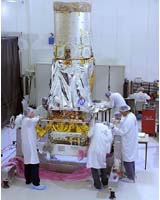
The Corot Space Telescope has completed its electromagnetic compatibility and vibration testing successfully and remains on schedule for launch this October, CNES said in a statement Wednesday.
Corot, technically a mini-satellite, carries a 1.1 meter (four foot) telescope – via a pair of parabolic mirrors – equipped with a 4-CCD wide-field camera.
It is expected observe at least 120,000 stars during its two-and-a-half-year primary mission, detecting extremely tiny variations in their brightness that could provide clues about their mass, age and chemical composition. Corot also will search for planets in the same size and temperature range as Earth.
The spacecraft will be launched into a circular polar orbit – at an altitude of about 900 kilometers (550 miles) – via a CNES Proteus platform atop a Russian Soyuz 2-1B rocket from Baikonur Cosmodrome in Kazakhstan. The orbit will enable Corot to focus on a fixed part of the sky for more than 150 days at a time.
The Corot mission is led by CNES, with participation by several French laboratories, ESA and AEB, the Brazilian Space Agency.
