
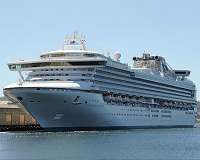
Another 41 people on a cruise ship quarantined off Japan have the new coronavirus, the country's health minister said Friday, confirming more on board will now be tested for the illness.
The newly diagnosed infections mean at least 61 people from the ship have contracted the virus, which has killed hundreds of people, most of them in China, and infected more than 30,000 on the mainland.
Japanese authorities have so far tested 273 people on board the Diamond Princess, which was quarantined after a former passenger, who disembarked in Hong Kong last month, was diagnosed with the virus.
"The results of the remaining 171 tests came out and 41 tested positive," Health Minister Katsunobu Kato told reporters.
"Today they will be sent to hospitals in several prefectures, and we are now preparing for that."
"In total, out of 273 specimens, 61 tested positive," he added.
The newly diagnosed include 21 Japanese, as well as Americans, Canadians, Australians, an Argentine and a Briton.
There were more than 3,700 passengers and crew on the ship when it arrived off Japan's coast on Monday evening. It docked in Yokohama on Thursday to resupply for a quarantine that could last until February 19.
Twenty people who were earlier diagnosed with the virus have already been removed from the vessel, including one who is in serious condition, a health ministry official said, without providing further details.
Testing was initially carried out on those who displayed symptoms or had come into close contact with the former passenger diagnosed with the virus.
But Kato suggested testing would now be expanded.
Authorities will "test those who are susceptible to illness, including elderly people and those with other ailments, as well as those who had close contact with the people newly diagnosed with the virus," he said.
There were no immediate details on how many people would meet those criteria or when the testing might take place.
– 'I want to cry' –
Japan has already reported at least 25 cases of coronavirus aside from the infections on board the ship, and evacuated hundreds of citizens from Wuhan, the Chinese city where the virus emerged.
A fourth evacuation flight carrying both Japanese citizens and non-Japanese spouses and those with other ties to the country arrived on Friday morning.
Japanese authorities have said the ship's quarantine may last until February 19, with passengers required to stay inside their cabins in a bid to prevent new infections.
Those on board have described their confusion and frustration as their luxury cruise descends into a nightmare.
"Just woke up from (a) sleepless night," wrote Yardley Wong, a Twitter user on board the ship.
"Getting so emotional… I want to cry."
David Abel, a British passenger who has been posting videos from the ship, said people were hearing information from media more quickly than authorities on board.
"It's not right. It's so unfair," he said.
But he praised the efforts of crew members who are now struggling to deliver meals to thousands of passengers in their cabins.
Those with inside cabins, which have no windows, have been allowed onto decks in small groups to get fresh air, but under strict conditions, including wearing a mask at all times when out of their rooms.
"The quarantine officials require that you avoid congregating in large groups and maintain a separation of at least one metre from each other when talking," the ship's captain said in an announcement on Friday morning.
"We require that you wear as a minimum, warm clothing, hat and a scarf if possible," he added.
A second cruise ship carrying a passenger suspected of infection with coronavirus will not be allowed to dock in southern Japan, the government said Friday.
Global fears rise as more China virus cases found on cruise ship
Beijing (AFP) Feb 6, 2020 –
China's coronavirus crisis deepened on Thursday with the death toll soaring to 563, as thousands of people trapped on quarantined cruise ships added to global panic about the epidemic.
More than 28,000 people have now been infected across China as authorities struggle to contain the outbreak despite compelling millions to stay indoors in a growing number of cities.
Two dozen countries have confirmed cases of the respiratory disease, which emerged from a market selling exotic animals in the central Chinese city of Wuhan late last year.
Thousands of people on cruise ships in Hong Kong and Japan now face an agonising wait to find out if more among them have been infected.
At least 20 people on board the Diamond Princess have tested positive so far, while some 3,700 passengers and crew from over 50 countries have been confined to quarters aboard the cruise ship off Yokohama since Monday night.
Japan Prime Minister Shinzo Abe said later Thursday that another huge cruise ship, the Westerdam, was heading to the country with one confirmed infected passenger aboard.
He said no foreigners from the vessel, capable of carrying nearly 3,000 passengers and crew, would be allowed to disembark.
In Hong Kong, 3,600 people were preparing to spend a second night confined aboard the World Dream as authorities conducted health checks after eight former passengers tested positive for the virus.
On Thursday, health officials in the financial hub said they were also asking some 5,000 Hong Kongers who had taken trips on the ship since mid-January to contact them.
Hong Kong has been particularly nervous as the disease has revived memories of another coronavirus, the one that causes Severe Acute Respiratory Syndrome (SARS), which killed nearly 300 people in the city and another 349 in the Chinese mainland in 2002-2003.
Panic buying in the semi-autonomous city left shelves of toilet paper empty at supermarkets following false online claims of shortages, prompting authorities to appeal for calm.
One person has died after contracting the virus in Hong Kong so far.
While the death toll continues to rise in China, health experts have stressed that at two percent, 2019-nCoV is far less deadly than the SARS pathogen, which killed around 10 percent of the people it infected 17 years ago.
But the outbreak has been declared a global health emergency, prompting several governments to warn against travel to China and ban new arrivals from the country, while airlines have halted flights.
In the latest international actions, Saudi Arabia banned its citizens and resident foreigners from travelling to China, while Air France-KLM decided to extend its flight suspension by another month until March 15.
In response Chinese President Xi Jinping told Saudi crown prince Mohammed bin Salman in a call that all countries should "understand and follow World Health Organization guidelines on travel and health in a timely manner", state news agency Xinhua reported.
– Temporary hospitals –
China has enacted unprecedented measures in a desperate bid to contain the virus, which spread far and wide as millions of people criss-crossed the country during the Lunar New Year holiday in late January.
But deaths and new infections continue to rise, especially at the epicentre of the epidemic in Hubei province, where 18 cities housing 56 million people have been under virtual lockdown since late last month.
A newborn was among the new cases in Wuhan, suggesting the baby was infected by the mother during pregnancy or immediately after.
There is still a shortage of 2,250 medical personnel in Hubei, deputy provincial governor Yang Yunyan said Thursday. The inability to offer health workers adequate protective gear is hindering the numbers that can be deployed on the front lines, he added.
With medical facilities in Hubei's capital Wuhan overwhelmed with patients, authorities were due to open a second field hospital, offering 1,600 beds.
The first hospital, with 1,000 beds, opened earlier this week, and authorities said they were converting public buildings into temporary medical facilities to deal with the influx of sick people.
The city of 11 million is facing a "severe" lack of beds, said Hu Lishan, a senior official in Wuhan, noting that there were 8,182 patients admitted to 28 hospitals that have a total of 8,254 beds.
There is also a shortage of equipment and materials, Hu said.
The central government has announced measures intended to ensure the supply of vital medical resources, with tax breaks for manufacturers of equipment needed to fight the epidemic.
"We must make all-out efforts across the country to meet the need for essential medical supplies and medical professionals in Hubei province," Premier Li Keqiang said, according to the official Xinhua news agency.
BGI Group, a genome sequencing company based in southern China, said it opened on Wednesday a lab in Wuhan able to test up to 10,000 people per day for the virus.
– Cities hunker down –
More cities are ordering people to stay indoors.
They include residents of Hangzhou, a city just 175 kilometres (110 miles) from Shanghai, where fences block streets and loudspeakers tell people: "Don't go out!"
In Beijing — where streets remain eerily quiet and businesses are shuttered — restaurants have been barred from accepting reservations for parties.
And in Nanchang, the capital of Jiangxi province which borders Hubei, pharmacists must send reports to the authorities on anyone buying fever or cough medicine.
The city has also limited the number of outings per family.
The outbreak has also hit major businesses.
Workers making iPhones at tech giant Foxconn's plant in Henan province, which borders Hubei, will be quarantined for up to two weeks, the company said.
