
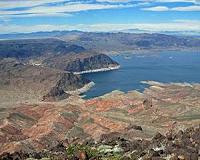
The 12- to 6-million-year-old Hualapai Limestone was deposited in a series of basins that lie in the path of the Colorado River directly west of the Colorado Plateau and has been deformed by a pair of faults that have slipped due to tectonic extension of the Earth's crust over this same time period.
Therefore, this rock unit represents an opportunity to study the sedimentary geology and deformational history over which the Colorado River first flowed after becoming a through-flowing river in the western Grand Canyon and Lake Mead.
In this study, we have quantified the deformation of the Hualapai Limestone using high-resolution aerial photography, detailed field studies of the stratigraphy, and numerical modeling of the deflections of the stratigraphy during faulting.
Specifically, we hypothesize that the Colorado River in the eastern Lake Mead region initially flowed over a low-relief surface developed over sediment-filled basins; the surface was warped as the faults continued to accrue displacement over the past six million years, causing spatial variations in apparent incision rate of the Colorado River as it incised through the deforming structure.
We further explore physically meaningful estimates of fault geometry that may have been responsible for the observed deflections using mechanical modeling. Our study thus examines linkages between fault geometry, fold geometry, and landscape evolution in a tectonically-active region.
