
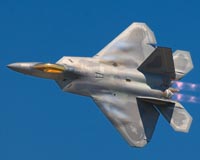
The House Armed Services Committee is currently reviewing a classified report it ordered last year on restarting production of the F-22 Raptor, according to a spokesperson for the committee.
"I can confirm that we received the report and are reviewing it," HASC spokesman Barron Youngsmith told UPI, declining to comment further due to the classified nature of the review.
Last April, the committee asked the Department of Defense what it would take to restart F-22 production and build 194 new fighters, which would bring the total fleet size to the Air Force's original requirement of 381 Raptors.
HASC chairman Mac Thornberry and others in Congress argued that Secretary of Defense Bob Gates reasons for canceling the program in 2009 — that they were inappropriate for the wars the United States was engaged in — no longer applied.
But Thornberry says a resurgent Russia and rising China must be countered with different and more advanced weapons than insurgents and militias in Iraq and Afghanistan.
Some estimates indicate it could take up to five years or longer for the new planes to start being delivered, and would cost additional tens of billions for modernization efforts. Factories used to build the F-22 have already been retooled for other uses, and Lockheed Martin's facilities capable of manufacturing stealth fighters would need expansion to accommodate both F-22 and F-35 production.
The F-22 is a 5th generation stealth air-superiority fighter with ground attack capabilities and is one of the most advanced fighters in the world. Cost overruns and the low-tech adversaries the U.S. was facing in Iraq and Afghanistan lead Gates to cancel the program after 187 aircraft were produced.
The F-22 has deployed to flashpoints like Eastern Europe and the Southwest Pacific as a deterrent, and has patrolled over Syrian air space recently as part of coalition operations there.
The Air Force declined to immediately comment on the report or the F-22 program.
Leonardo receives NATO surveillance system contract
Washington (UPI) Jun 20, 2017 –
Leonardo has received a contract to provide services and develop logistical and control systems for NATO's Alliance Ground Surveillance program, the company announced on Wednesday.
Leonardo has been chosen by the NATO Alliance Ground Surveillance Management Agency to develop and maintain key elements of the AGS. Leonardo is a member of the Northrop Grumman led consortium developing the NATO AGS Core System.
The contract includes the AGS Logistics Information System, Mission Operational Support systems and Transportable General Ground Stations. It provides for spare parts, maintenance, training and operational support for the systems.
ALIS is a centralized logistics database that will aid in planning and management of maintenance, repair, warehousing, and personnel management and training. across the AGS program. It will also be used to maintain the NATO AGS Core baseline for maintenance activities.
The MOS and TGGS main responsibility is to collect data, photographs and video from remotely piloted aircraft and deliver them for intelligence analysis along with command and control and other duties. Leonardo will provide a Wide Band Data Link for the two systems.
The NATO Alliance Ground Surveillance program is based out of Sigonella, Italy. The system will be acquired by 15 members of NATO during 2017 and 2018.
It includes five dedicated RQ-4 Global Hawk remotely-piloted aircraft. The Global Hawk will provide border, ground, and maritime surveillance to NATO for security, defense, counterterrorism and disaster relief coordination.
A network of ground stations will also collate and deliver for analysis data from a wide variety of intelligence gathering systems such as signals intercepts and national surveillance systems.
Northrup Grumman to upgrade F-16 radars
Northrop Grumman is to upgrade dozens of U.S. Air National Guard F-16s with APG-83 Scalable Agile Beam Radar, the company announced this week.
The APG-83s will be the active electronically scanned array for 72 ANG F-16s to meet a U.S. Northern Command Joint Emergent Operational Need for homeland defense.
"AESA radar upgrades are critically important to give the F-16 community t … read more
