
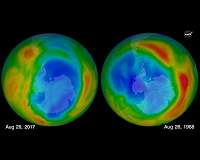
The successful phase-out of ozone-depleting chlorofluorocarbons (CFCs) following the landmark 1987 Montreal Protocol has set Earth's protective ozone layer on the path to recovery.
Now, compounds developed to replace CFCs for air conditioning and refrigeration have been found to decay into persistent organic pollutants, accumulating in water, soil and ice in the northern hemisphere, and likely globally, according to a new study in AGU's journal Geophysical Research Letters.
The pollutants, known as short chain perfluoralkylcarboxyilic acids (PFCAs), form when volatile CFC replacement compounds breakdown as they spread through the atmosphere. The new study found increasing amounts of three of the smallest members of the short chain PFCAs captured in the yearly layers of ice cores in the Canadian Arctic, starting in 1990.
Little is currently known about the human health risk of short chain PFCAs, but the compounds are toxic to some plants and invertebrates, and accumulate in plants, including food crops. The ice caps are experiencing accelerated warming, which will eventually release these pollutants into surface water, potentially magnifying their long-term impact on the environment and society, according to the study's authors.
"Our measurements provide the first long-term record of these chemicals, which have all increased dramatically over the past few decades," said Cora Young, an atmospheric chemist at York University in Toronto, Canada, and the corresponding author of the new study. "Our work also showed how these industrial sources contribute to the levels in the ice caps."
The new study demonstrates the omnipresence of these persistent pollutants and the need to consider different environmental hazards concurrently in international agreements, the authors said.
"We went to ice caps with no human inhabitants, 3,000 kilometers away population centers and two kilometers in elevation-basically the cleanest source we could find," said Amila De Silva, an environmental chemist at Environment and Climate Change Canada, a government program in Burlington, Ontario, and co-corresponding author of the new study.
Lasting legacy
PFCA compounds are chains of carbon atoms bonded to fluorine, making the molecules long-lived and impervious to natural processes that break down pollutants, according to the authors.
"[PFCAs] are known as the forever molecules. Carbon-fluorine is the strongest bond you can have," De Silva, said. "Persistence is a big problem for the environment, because it's the dose that makes the poison."
Public concern has focused on long chain PFCAs, which have been found to be toxic to animals, including humans, with adverse reproductive effects, and a tendency to bioaccumulate and become concentrated in higher levels of the food chain. They bind to blood and can remain in the body for years, according to De Silva. Long chain PFCAs are prevalent in living spaces due to broad use of their precursor molecules in industrial and commercial products.
There is less information about short chain PFCAs, the type found in the new study. Short chain PFCAs are harder to detect and analyze because they are so small, De Silva said.
Unintended consequences
Signatories to the Montreal Protocol, negotiated by the United Nations, agreed to replace CFCs with hydrochlorofluorocarbons and eventually hydrofluorocarbons, which are less destructive to ozone in the stratosphere, which filters hazardous ultraviolet radiation. These mandated replacement substances have subsequently been regulated as well, but the international agreements only addressed the threat to ozone, not other environmental and health hazards.
"Our results suggest that global regulation and replacement of other environmentally harmful chemicals contributed to the increase of these compounds in the Arctic, illustrating that regulations can have important unanticipated consequences," Young said.
"We're recommending a more holistic approach," De Silva said.
"Ice core record of persistent short-chain fluorinated alkyl acids: Evidence of the impact from global environmental regulations"
