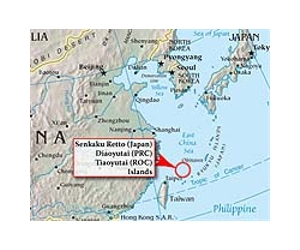
The disputed islands at the heart of a bitter diplomatic spat between Beijing and Tokyo are covered by the Japan-US security treaty, Hillary Clinton told Japan's foreign minister Thursday, reports said.
Under the 1960 treaty, the United States is obliged to defend Japan against any attack on a territory under Tokyo's administration.
Japanese Foreign Minister Seiji Maehara told reporters after his meeting with the US secretary of state that Clinton had acknowledged the Senkaku islands — known as the Daioyu islands by China, which also claims them — were subject to the treaty, Kyodo News Agency reported from New York.
"According to the Japanese minister, Clinton said that the Senkakus… are subject to Article 5 of the bilateral security treaty, which authorizes the U.S. to protect Japan in the event of an armed attack 'in the territories under the administration of Japan'," the report said.
The dispatch did not quote Maehara directly.
State Department spokesman Philip Crowley separately told reporters the United States takes no position on the sovereignty of the islands.
"The issue of the Senkakus is complicated," Crowley said in New York.
He said that Maehara explained to Clinton that the Japanese are "pursuing this case through their legal system and that they expected to be able to resolve it, and we simply encouraged that to happen as soon as possible".
Relations between Tokyo and Beijing have soured since the arrest earlier this month of the captain of a Chinese fishing boat following a collision with two Japanese coast guard vessels near the islands in the East China Sea.
Japan says the captain deliberately rammed the vessels and continues to hold him, despite repeated angry demands from China for his release.
In a possible escalation of the dispute, China's state media reported Thursday that four Japanese nationals were being held in the north of the country over allegations they had filmed military installations.
Officially pacifist Japan hosts a large US military contingent, on which it has depended for its protection since renouncing aggressive warfare six decades ago.
earlier related report
Clinton urges dialogue to resolve China-Japan row
New York (AFP) Sept 23, 2010 –
US Secretary of State Hillary Clinton urged Japan Thursday to pursue dialogue with China in a bid to resolve quickly a row over a Chinese trawler captain detained near islands claimed by both countries.
The United States also stressed the need to avoid an escalation of the row as Japanese media reported Clinton told Japanese Foreign Minister Seiji Maehara in New York that the islands are covered by the Japan-US security treaty.
Under the 1960 treaty, the United States is obliged to defend Japan against any attack on a territory under Tokyo's administration.
In meeting with Maehara, Clinton sought to "encourage dialogue and (voiced) hope that the issue can be resolved soon," her spokesman Philip Crowley said, adding that Japan-China ties "are vitally important to regional stability."
Maehara told the chief US diplomat that Tokyo is trying to resolve the row based on its legal process and international law, Crowley told reporters after the meeting on the sidelines of the UN General Assembly in New York.
"We are not mediating per se. We have not been asked to play a particular role," he said, adding that this is an an issue two "mature countries" like China and Japan are "fully capable of resolving."
"Our sense is that neither side wants to see this situation escalate to the point that has long-term regional impact," Crowley said.
He added: "We continue to encourage both sides to do everything to resolve it and certainly not to escalate it."
He said that the dispute also came up earlier this week in US-Chinese talks.
US President Barack Obama met Thursday in New York with Chinese Premier Wen Jiabao, who told the UN General Assembly his country would not threaten another nation but would not yield in disputes over its national interests.
"When it comes to sovereignty, national unity and territorial integrity, China will not yield or compromise," Wen said in a speech.
But Wen insisted that China would not seek hostilities.
He did not mention the islands dispute or other tensions in Asia.
Obama was also due to meet with Japanese Prime Minister Naoto Kan but Crowley said he could not predict whether the spat would come up in the high-level US talks with either country.
Maehara's press secretary Satoru Satoh told AFP late Wednesday that Japan wants to communicate with China but that no meetings are planned yet between Japanese and Chinese officials in New York.
Maehara told reporters after his meeting here that Clinton had acknowledged the Senkaku islands — known as the Dadirectlyioyu islands by China — were subject to the treaty, Kyodo News Agency reported from New York.
"According to the Japanese minister, Clinton said that the Senkakus… are subject to Article 5 of the bilateral security treaty, which authorizes the US to protect Japan in the event of an armed attack 'in the territories under the administration of Japan'," the report said.
The dispatch did not quote Maehara .
China's premier has threatened "further actions" if Japan does not release the trawler captain, who was detained September 7 by the Japanese coast guard near the islands in the East China Sea between Taiwan and Japan's Okinawa island.
Crowley said the United States takes no position on the sovereignty of the islands.
China has summoned Japan's ambassador five times, demanded the release of the boat's captain and scrapped talks on joint exploration of a gas field near the disputed islands.
China, meanwhile, Thursday denied a report that it had blocked exports to Japan of rare earth minerals to Japan, which are essential for making iPods, electric cars, missiles and a range of other products.
Share This Article With Planet Earth