
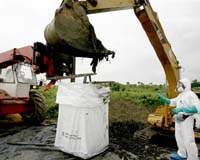
In this north Abidjan district men in white overalls are using mechanical diggers to extract toxic mud from the city's main household waste dump. It is gooey and black, and it stinks of garlic. The dump, in the district of Akouedo, is one of around fifteen sites in the Ivorian commercial capital where untreated toxins were wantonly offloaded on the night of August 19, eventually poisoning tens of thousands of people, seven of them fatally.
Akouedo was one of the worst-hit areas, with three separate sites affected, and the Ivorian authorities have designated it as the first priority for cleaning up.
Around 20 technicians from the French firm Tredi have been at work on the largest site since Sunday, pumping the waste out and isolating it.
On the second Akouedo dump the diggers are working in a crater covered in a thick layer of polluted earth that is obvious even to the naked eye.
Each load is meticulously placed into a plastic bag one cubic metre (1.3 cubic yards) in volume. Along with the liquid waste, these will be stored in the coming days in a secure warehouse prepared by the Ivorian authorities.
Not far away, a Dutch team is working on a third location, pounding the contaminated banks of a dried-up stream with water cannon in order to liquidise the polluted earth so it can be pumped out, as the diggers cannot access it.
"It's going pretty well but we have to stop quite often to drink, because we lose a lot of water in these suits and gas masks," says Nick, one of the technicians.
A third team is weighing the excavated barrel-loads, observed by an Ivorian official. The quantity of waste excavated is one of the factors determining the eventual cost of the operation.
Local residents are helping the depollution teams, among them Akouedo's environment officer, Leonard Danho, 35, also kitted out in white overalls and gas mask.
"When the depollution teams came," he says, "we had already identified the affected zones. We showed them where they were and since then I've been working with them and acting as a bridge between them and the population."
Inhabitants of Akouedo have been doubly affected by the dumping: as well as inhaling poisonous substances, many of them live off food they grow on allotments on the site, which is normally only partly given over to waste.
Those parcels and all of their produce will now have to be destroyed. The Ivorian agriculture ministry has promised to compensate their owners, and on Thursday morning its representatives began registering those eligible.
The clean-up operation should eliminate the immediate risk of poisoning in Akouedo within the next few days, but some residents are worried about the potential long-term consequences for their health.
"With this gas, your head burns as if it had pepper in it," says Elisabeth Ahouto. "How do I know what this gas will do to my brain in the months and years to come?"
Source: Agence France-Presse
