
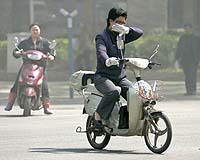
Air and water pollution are global issues, but in poverty-stricken Southwest China they're causing a health crisis. Lack of access to safe drinking water and high levels of air pollution and mercury contamination from excessive coal-burning are causing chronic illness and death, especially in the rural areas of China. A possible link between mercury content in fish consumed in the United States and Chinese coal-burning is also being examined.
The United States Agency for International Development is sponsoring the China Environmental Health Project, which began in October. Scientists from Western Kentucky University and Southwest University of China are studying the pollution of underground streams, pollution caused by coal-burning and the health effects on the people. Initial findings were released at a news conference this month at the Woodrow Wilson International Center for Scholars.
Water and air pollution have led to chronic health problems — gastric disorders, diarrhea, asthma, bronchitis, conjunctivitis — as well as acute poisoning and death, said Chris Groves, Western Kentucky University scientist. The people in the areas most affected are living below the poverty level of $85 a year.
The area is called a karst region, meaning it is created by the slow dissolution of bedrock.
"Karst is the most vulnerable ground water system to contamination," he said.
Underground springs exist in karst areas, most commonly in limestone. These landscapes also occur in the United States in Florida and Kentucky, but in China approximately one-third of the land is karst region, Groves said. The karst landscape, along with monsoon seasons alternating with drought, make accessibility to any water at all difficult. The water that can be found is often contaminated.
In the case of one Florida aquifer, a trash-filled sinkhole, a highway and a chemical-storage plant run above it, and millions of people get their water from that aquifer. But "we're lucky" in the United States, Groves said. There are water-treatment facilities, and comparatively speaking, the water is not as highly contaminated as the aquifers in China.
In China, rice-field farmers who use fertilizer and pesticides are polluting their own water. Toxins from steel mills also contaminate the underground water. Acid rain has also become an issue; in the village of Fantang the effects are especially severe.
"No one from the village is healthy enough to join the army," said Yuan Daoxian, professor at Southwest University of China.
There are also roads that run above the underground water system.
"Pollution from roadsides recharge drinking water tanks," Daoxian said.
In China people spend as much as three hours climbing down into caves to retrieve buckets of water, especially during the dry season.
"If they're spending time carrying water, then they're not making money," Daoxian said.
People also dry their food inside during the wet season, and it can be poisoned with arsenic from the coal-burning fire emissions, he said.
Technology exists to treat water and make it safe and drinkable, but not in these poor regions.
"Their treatment means boiling water, and probably over a coal-fired stove. They don't know any better," Groves said.
High rates of coal-burning in China — combined with unpublished reports on exactly how much particle pollution is getting into the air — are cause for alarm, said Wei-ping Pan, a Western Kentucky University scientist. Data on emissions from large coal-consuming regions, like Huainan, are the focus of the coal portion of the study.
Some U.S. studies have shown that when mercury is ingested it accumulates in the brain and attacks the nervous system, Pan said. It can also cause symptoms including hair loss, fatigue, depression, difficulty concentrating and headache.
The Environmental Protection Agency said that tiny particles of mercury travel through smokestacks into the air and fall onto soil or water. One of the most common sources of mercury contamination is coal-burning power plants.
Up until now little research has been done to draw connections between the coal-burning in China and illness both in China and on the West Coast of the United States, Pan said.
"It's possible that Huainan mercury ends up in the fish people in California eat," Pan said.
Trends of high miscarriage rates and lower IQ rates have also been appearing, but there's still a lack of data.
"Just because there's no data doesn't mean there's not a problem," Groves said.
The answer lies in the sharing of knowledge and technology, Pan said. By bringing the clean-burning advances from the United States to China, air pollution could be greatly reduced, hopefully cutting cases of asthma and bronchitis as well.
Source: United Press International
