
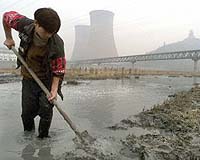
Water quality in China's cities is still worsening due to inadequate controls over pollution in many areas, the government said Tuesday, pledging to spend 125 billion dollars over five years on the problem.
"I can clearly tell you, our country's water situation is deteriorating overall," Qiu Baoxing, vice minister of construction, told a press conference. "In a word, improvement in some areas, but deterioration overall."
Qiu blamed inadequate control over pollution from household, industrial and agricultural uses.
The pollution of water sources, frequent accidents such as pollution spills, the lack of waste water treatment facilities in some cities and inadequate policies to encourage water conservation were "prominent problems," he said.
The Ministry of Construction said in a statement released Tuesday that continuous over-exploitation of groundwater has lead to a "drastic" decline of the water table and exhaustion of water sources in some areas.
By the end of 2005 there were still 278 Chinese cities which had no waste water treatment facilities, it said, adding that the pollutants in industrial discharges in those places were often above permitted national standards.
Many cities are also operating water-consuming and highly polluting showcase projects and are not pursuing policies to encourage water saving, it said.
More than 150 cities had not imposed waste water treatment fees on households and enterprises as of the end of 2005, it said.
Over the next five years, Qiu said his ministry aimed to invest one trillion yuan (125 billion dollars) on projects across Chinese cities, including plans to renovate old and damaged water pipelines and construct more wastewater and garbage treatment facilities.
The budget also included the South-North water diversion project and the desalination of sea water, he added.
Waste water tariffs will also be imposed in all cities and towns by the end of this year, the ministry said.
More than 70 percent of China's rivers and lakes are polluted, while underground water supplies in 90 percent of its cities are contaminated, according to previous state press reports.
Source: Agence France-Presse
