
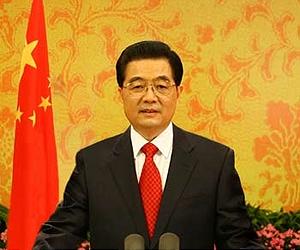
has seen record economic growth, greater openness driven by Internet and social media use, yet also an unbending political system. Among notable events are:
November 2002: The ruling Communist Party names Hu as its leader, or general secretary, at its 16th party congress, which is held every five years.
March 2003: Hu also assumes the role of head of state at the annual gathering of the National People's Congress, or parliament, while Wen Jiabao becomes premier.
October 2003: China becomes the third country to send a man into space, after the Soviet Union and United States.
December 2004: IBM sells its personal computer division to Chinese computer maker Lenovo.
July 2006: A new railway — the world's highest — opens connecting Tibet with the rest of China.
January 2007: China fires its first anti-satellite missile in what Western nations interpret as an aggressive move.
October 2007: China launches its first lunar probe, Chang'e, inaugurating an ambitious space programme aimed at sending an astronaut to the moon.
March 2008: Riots erupt in the Tibetan capital of Lhasa and nearby Tibetan regions, leaving 20 dead according to officials and 203 dead according to Tibetans in exile.
March 2008: Xi Jinping is named vice president.
May 2008: A massive earthquake in southwestern Sichuan province kills 87,000 people.
August 2008: Beijing hosts the Olympic Games, where Chinese athletes win the most gold medals.
September 2008: A food scandal — in which milk is laced with the chemical melamine — kills six babies and sickens 300,000 others.
November 2008: Authorities unleash a stimulus package worth four trillion yuan (about $640 million today) to counter the global financial crisis.
November 2008: First commercial airliner made in China, the ARJ-21, starts flights.
July 2009: Clashes between ethnic Uighurs and majority Han in the northwestern city of Urumqi leave 200 dead and 1,600 wounded, prompting China to block Facebook and Twitter.
December 2009: China overtakes Germany as the world's top exporter.
May 2010: The World Expo in Shanghai draws 73 million visitors over several months.
October 2010: Chinese dissident Liu Xiaobo wins the Nobel peace prize while he is serving an 11-year prison sentence for calling for the end of the Communist party's ruling monopoly.
December 2010: China surpasses Japan to become the world's second largest economy.
Early 2011: Fearing a spillover effect from the "Arab Spring" popular revolts in the Middle East, authorities crack down on dissidents including well-known artist Ai Weiwei, who is detained for three months.
June 2011: A high-speed train running the 1,300 kilometres (810 miles) from Beijing to Shanghai opens.
Late 2011: City-dwellers outnumber the rural population for the first time, while the number of Internet users tops 500 million in September.
April 2012: Senior leader Bo Xilai is brought down following revelations about the murder of British businessman Neil Heywood.
April 2012: The blind activist Chen Guangcheng escapes house arrest and takes refuge in the American embassy in Beijing before leaving for the United States.
July 2012: The massive Three Gorges dam reaches full capacity, matching the output of 15 nuclear reactors, or 22.5 gigawatts.
November 2012: The 18th Party Congress opens, where Hu is expected to step down as leader, to be replaced by Xi.
